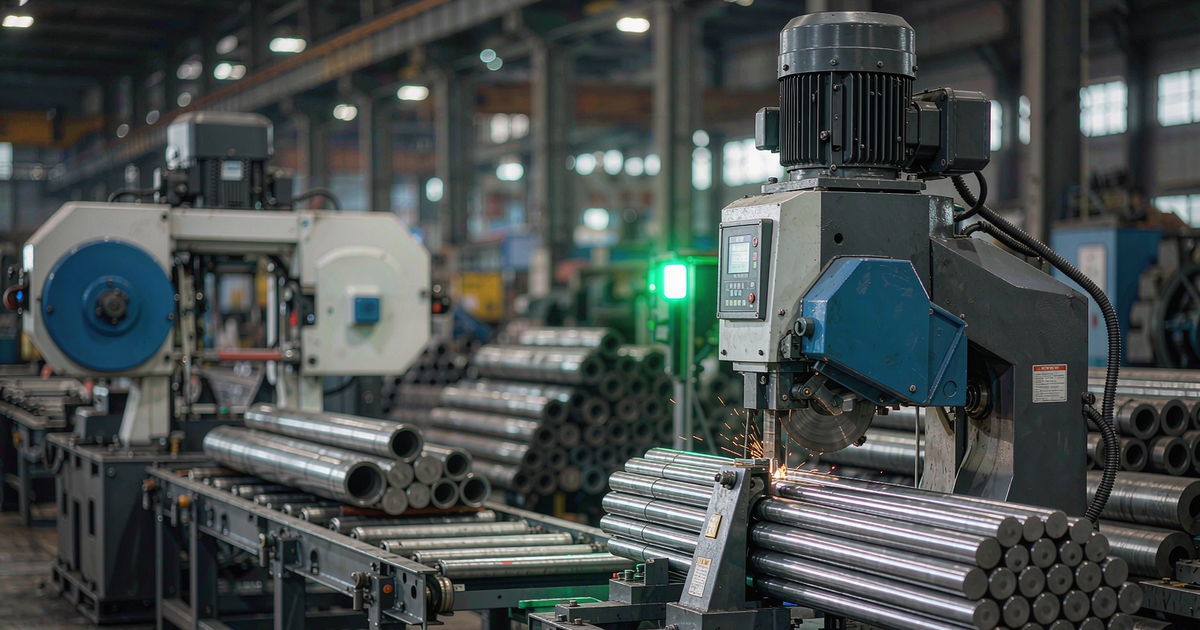
In an automotive plant or a forging shop, sawing is rarely the operation anyone worries about — until it becomes the bottleneck. A bar-cutting cell that runs 20% too slow caps the throughput of every downstream CNC lathe, and a billet cut with a 0.4 mm length error silently adds machining allowance to every single part that follows. Specifying a sawing line is therefore not a question of “which machine cuts metal”, but of what takt time, what tolerance, and what material mix your line has to support, shift after shift.
KEENSAW builds both CNC carbide circular saws and heavy-duty band saws, which means the recommendation below is not a sales pitch for one architecture — it is the decision logic we use when a customer sends us a part drawing and a monthly volume. This guide walks through that logic for two very different worlds: high-volume automotive bar cutting and large-section forging billet cutting.
Automotive components — shafts, gear blanks, steering parts, fastener stock, suspension sleeves — almost all begin as a cut length of bar. That first operation sets three hard constraints for everything downstream:
A general-purpose saw with a manual stop and a gravity roller table fails all three. It is not that the machine cannot cut — it is that the variance between operators and between bars destroys the schedule. That is why automotive cells are specified as a system: servo feed, powered length stop, hydraulic clamping on both sides of the cut, and chip/bar handling sized for the shift, not just for the machine.
For high-mix, mid-volume work, a KCS-120C automatic high-speed circular saw or a KCS-100C full-automatic circular sawing machine covers the Ø20–120 mm band with cycle times measured in seconds. Where the parts are smaller — Ø10–70 mm — the KCS-70C and KCS-75S run the same cell logic at a lower capital cost. For lines where bar and tube are mixed, the KCS-160C handles both without a changeover.
Forging is the opposite problem: fewer, much larger, much harder cuts. A billet of Ø300 mm 42CrMo4 presents roughly 35× the cross-section of a Ø50 mm automotive blank, and die steels such as H13 or D2 arrive hardened or in the annealed-but-abrasive state that eats cutting edges. The dominant failure mode here is not slow cutting — it is deflection. If the frame, the guide or the blade lacks rigidity, the cut wanders, the blade wears unevenly, and you get tapered faces and premature tooth failure.
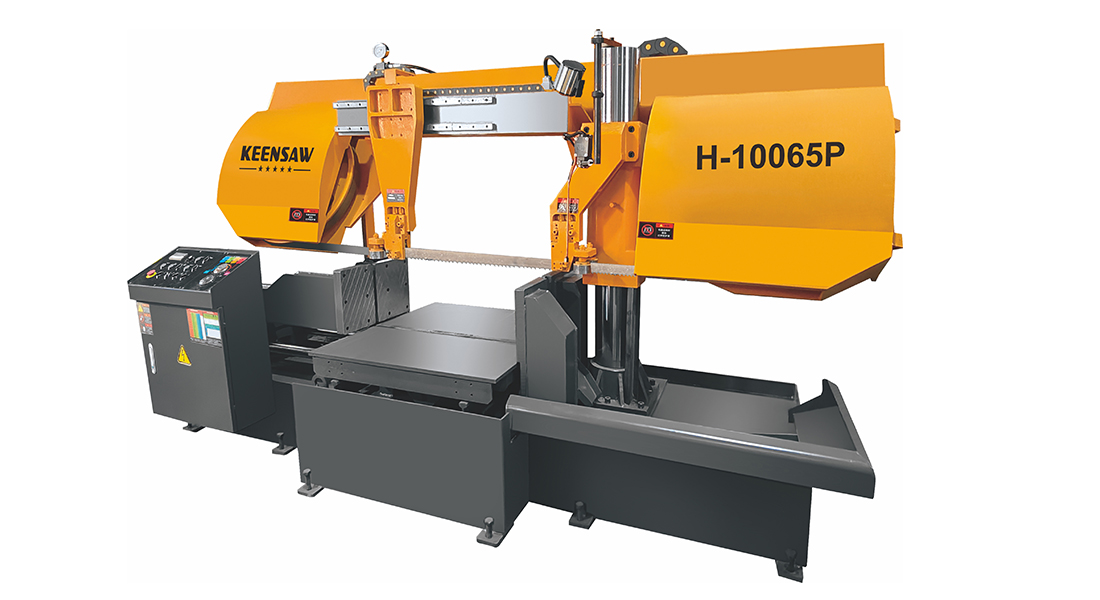
Horizontal band saw configured for die steel and large forging billets — rigidity and controlled feed matter more than raw speed.
Three design choices decide whether a billet saw survives production: a twin-column or gantry frame that keeps the blade square through the full stroke, a hydraulic or servo-controlled feed that holds a constant cutting force instead of a constant rate, and generous coolant delivery at the tooth gullet. KEENSAW’s H-10065HP is a dedicated die-steel machine built around exactly that; for Ø650 mm sections the GZ4265 and the G4265ZA heavy-duty miter band saw carry the same brief with a larger throat. We covered the engineering behind this in Heavy-Duty Dual-Column Band Saws: Engineering Rigidity for Large Billets and Forging Steel.
The single most useful filter is diameter versus volume. Below roughly Ø150 mm at sustained volume, a carbide circular saw wins on cycle time and surface finish. Above roughly Ø250 mm — or for any section where material cost per billet is significant — the band saw wins on kerf loss and on the ability to handle hard, work-hardening alloys without punishing blade cost. Between the two there is a genuine trade-off zone where the answer depends on your mix.
| Factor | CNC carbide circular saw | Heavy-duty band saw |
|---|---|---|
| Practical diameter | Ø10–160 mm (to Ø230 mm on large frames) | Ø250–650 mm and above |
| Cycle time | Seconds — typically 3–8 s on Ø50 mm carbon steel | Tens of seconds to minutes, scales with section |
| Cut accuracy | ±0.05–0.10 mm, squareness within 0.05 mm | ±0.10–0.25 mm typical, better on gantry frames |
| Kerf (material lost) | ~2.2–3.0 mm | ~1.3–1.6 mm — a real saving on large sections |
| Surface finish | Near-machined, often no facing needed | Saw marks present; usually fine for forging |
| Best for | High-volume bar and tube, tight length tolerance, cell automation | Large billets, die steel, hard alloys, mixed large sizes, material-saving cuts |
Where volumes are high enough to justify automation but sections are large, ultra-high-speed automatic band saws such as the BSVP650CNC and the 530TS horizontal automatic band saw narrow the cycle-time gap considerably. If you are comparing a circular saw against a cold saw rather than a band saw, see CNC Circular Saw vs Cold Saw: The Ultimate Guide.
A sawing line is only as fast as its slowest transfer. The machines that make the difference are usually the ones nobody specifies carefully: the loader that presents bar without a nudge from an operator, the stop that holds ±0.1 mm over a 6 m bar, and the chamfer unit that removes the burr before it reaches a robot gripper.
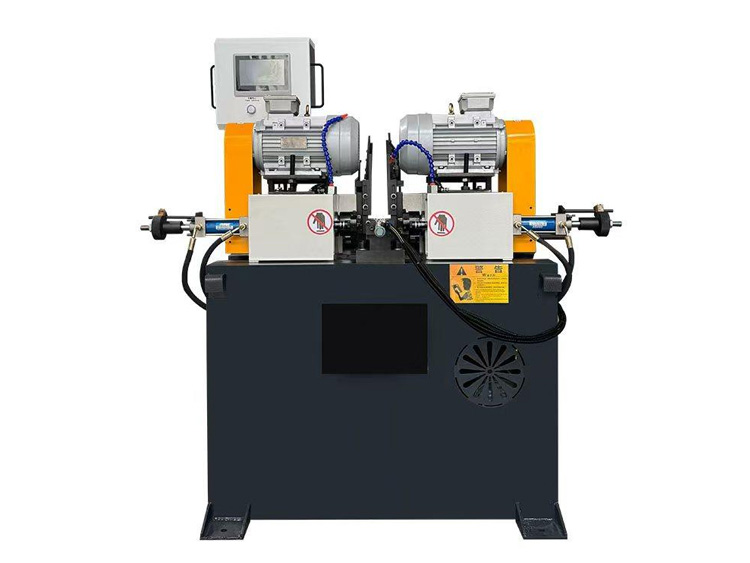
Double-end chamfering of short blanks — the step that lets cut parts go straight to gauging or robot handling.
A practical automotive cell looks like this: a bundle or magazine loader feeds bars to a servo gripper feed; the saw cuts against a powered length stop; cut blanks transfer to a KCM-50ST double-end chamfering machine for short parts or a KCM-120DE / KCM-90DE for longer tube; then marking and sorting. On stud and fastener lines, a fully automatic stud chamfer and stamping marking machine closes the loop in one station.
Choosing how much of this to automate is a volume question, not a technology question — we broke the thresholds down in From Semi-Auto to Full CNC, and the handling side in The Industrial Automation Blueprint. If your constraint is specifically deburring throughput, Integrating Cutting & Chamfering covers the line-balancing maths.
Blade selection is where most “the machine is slow” complaints actually originate. A TCT blade run at stainless-steel speeds on alloy steel will glaze and burn; a bi-metal band run at carbon-steel speeds on H13 will lose teeth in a shift. The table below gives typical starting parameters — always confirm against your own section, hardness and coolant setup with a KEENSAW application engineer.
| Material | Circular saw blade & speed | Band saw blade & speed |
|---|---|---|
| Low/medium carbon steel C45 / 1045 |
TCT blade, 80–120 m/min, 0.08–0.12 mm/tooth | M42 bi-metal, 60–90 m/min |
| Alloy steel 42CrMo4 / 4140 |
TCT, 60–90 m/min, 0.06–0.10 mm/tooth | M42 bi-metal, 45–70 m/min |
| Stainless steel 304 / 316 |
PVD-coated TCT, 30–50 m/min, 0.05–0.08 mm/tooth | M42 / M51 bi-metal, 25–45 m/min |
| Aluminium 6061 / 6063 |
TCT for non-ferrous, 300–600 m/min, 0.08–0.15 mm/tooth | Rarely economic; use a circular saw |
| Die / tool steel H13 / D2 |
Only with reduced parameters and heavy coolant | M51 bi-metal, 30–50 m/min |
For slower, conventional applications an HSS circular saw blade remains a cost-effective choice, particularly on smaller sections and intermittent duty. The full range, including bi-metal bandsaw blades, is worth reviewing before you standardise on one specification across a shop.
Two numbers decide the business case: seconds per cut and millimetres of kerf. The first drives labour and machine-hours; the second quietly drives material cost, and on large sections it can exceed the cost of the blade by an order of magnitude.
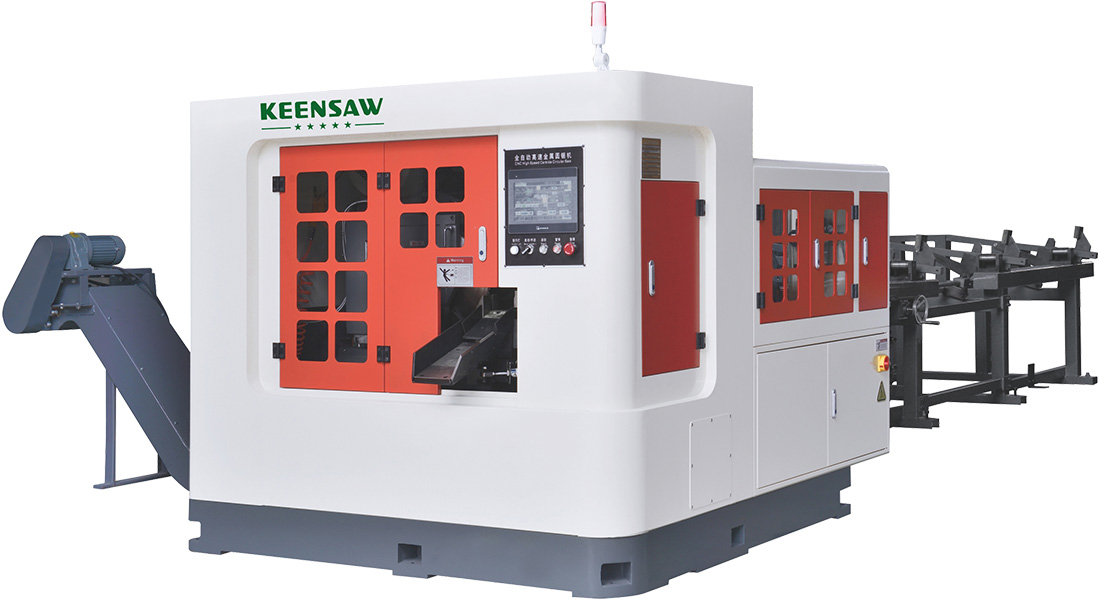
KCS-120B high-speed circular saw — cycle times in seconds are what make a three-shift automotive cell viable.
| Example | CNC carbide circular saw | Heavy-duty band saw |
|---|---|---|
| Cut Ø50 mm C45 bar | ~3–6 s per cut | ~25–40 s per cut |
| Kerf loss per cut | ~2.5 mm | ~1.4 mm |
| Material saved per 100,000 cuts (Ø300 mm billet) | Baseline | Several tonnes of steel per year |
| Where the cost lands | Lower labour and machine time; higher blade cost per hour | Lower blade and material cost; higher cycle time |
The arithmetic flips with diameter. On Ø50 mm bar, the circular saw’s time advantage dominates. On Ø400 mm billets, the band saw’s kerf advantage plus its ability to hold a stable cut in hard alloy usually wins even though each cut is slower. This is exactly the calculation we run with customers before quoting a line — and it is why the honest answer to “which is cheaper?” is “it depends on your section and your volume.”
Blade life is the other half of the model. We published a detailed treatment of it in Maximizing TCT Blade Life and Tonnage Output in Mass Production.
For sustained volume below about Ø150 mm, a CNC carbide circular saw gives the cycle time and length repeatability an automotive cell needs. Above that, or where the section is large and material cost per billet matters, a band saw is usually the better economics.
A hardened, coarse-pitch bi-metal blade with controlled feed. M42 covers most alloy steels; for H13, D2 and other difficult die steels, step up to an M51 band saw blade and reduce speed into the 30–50 m/min band with generous coolant.
It depends almost entirely on how much operator time you remove and how much downstream capacity you unlock. On three-shift automotive work, removing one operator and eliminating a facing operation often pays back in well under two years; on low-volume jobbing work, semi-automatic remains the sensible choice.
With the right blade and parameters, hardened alloy and die steels in the 30–45 HRC range are routine on our heavy-duty band saws. Above that, or for exotic alloys, send us the specification — the answer is usually a parameter and blade change rather than a different machine.
If you run more than a few thousand identical lengths per month, or any job where an operator is standing at the saw waiting for it, yes. Below that, a semi-automatic machine with a good length stop is usually the better capital decision. See From Semi-Auto to Full CNC for the thresholds.
Three things together: a servo gripper feed rather than a friction push, a powered length stop that is measured rather than set by hand, and thermal stability — let the machine reach operating temperature before qualifying parts, and keep coolant temperature consistent. Clamping on both sides of the cut also prevents the drop-off from lifting and skewing the part.
Specifying an automotive or forging sawing line comes down to four decisions: section size (circular saw or band saw), volume (how much automation), material (blade and parameters), and downstream requirement (do you need chamfering and marking in line?). Get those four right and the machine choice largely makes itself.
KEENSAW supplies the whole chain — CNC carbide circular saws, heavy-duty band saws, chamfering machines and saw blades — with CE certification and ISO9001:2016 quality control, exported to more than 40 countries.
Send us your part drawing and monthly volume — we will size the line for you.
Our application engineers will recommend the cut method, blade specification and automation level, with cycle-time and cost-per-cut estimates before you commit. Contact KEENSAW for a free sawing line assessment →
Contact us if you have any questions we will reply as soon aspossible