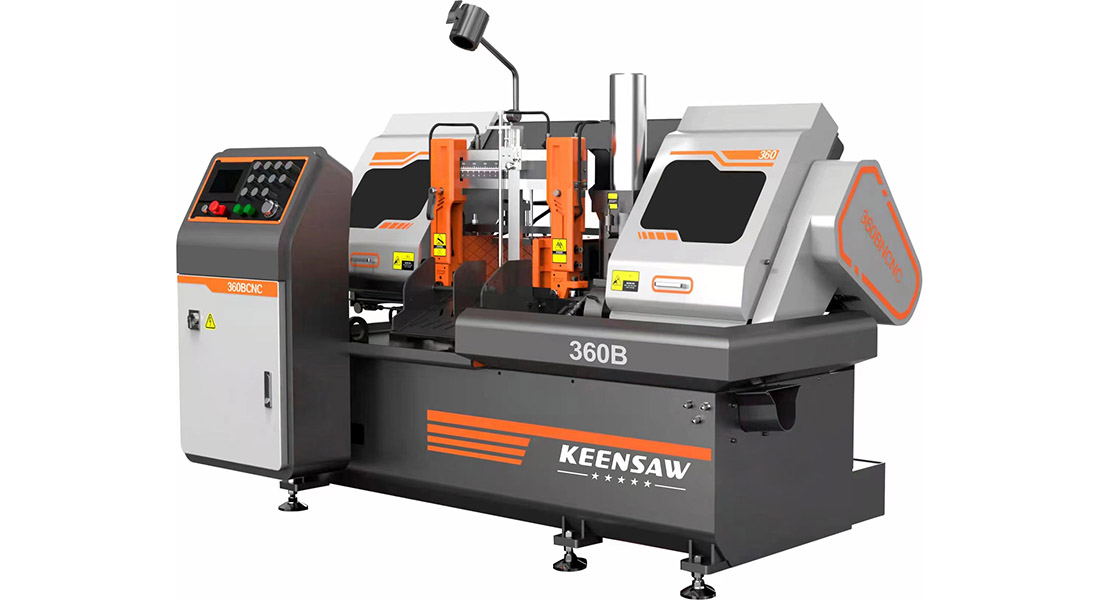
In heavy industrial environments, such as service steel centers, heavy-duty forge shops, and shipyards, the cutoff department faces unmatched mechanical stress. Processing large alloy billets, hardened tool steels, and oversized raw ingots requires enormous cutting forces. For these severe applications, an ordinary pivot-style or scissor-type saw cannot deliver the required precision. To secure continuous productivity, implementing a robust heavy duty dual column band saw is an engineering necessity.
When cutting through heavy steel cross-sections, a sawing system must withstand immense twisting torques and continuous downward pressures. Without a rigid structural foundation, the saw blade will experience subtle tracking deviations, leading to out-of-square cuts, ruined workpieces, and expensive tool breakage. This technical sourcing brief explores the engineering mechanics behind dual-column stabilization and outlines why it remains the gold standard for high-capacity heavy duty fabrication band saw operations.
Many general fabrication facilities attempt to stretch the limits of their traditional hinge-type horizontal saws to handle large billet cutting capacity tasks. This approach frequently results in immediate tool wear and irregular cuts due to the inherent flaws of pivot mechanics.
A scissor-style saw operates on a single pivot hinge, creating a cantilever load distribution. As the blade penetrates deeper into a wide, solid metal log, the cutting force is concentrated closer to one side of the machine frame. This uneven load distribution causes microscopic structural twisting. In heavy industrial applications, even a fraction of a millimeter of frame flexing twists the blade matrix, leading to crooked cuts and immediate tooth stripping.
Conversely, a premium heavy duty dual column band saw utilizes a rigid gantry-style design where the saw frame moves vertically along two ground, solid steel pillars. Backed by dual-cylinder synchronous hydraulic downfeed systems, the machine distributes the cutting load symmetrically across both sides of the chassis. This structural symmetry completely eliminates frame deflection, ensuring the blade encounters a perfectly parallel, predictable resistance through the entire depth of the metal billet.
Forged materials possess inconsistent cross-sectional hard spots, oxidized scale layers, and high internal stresses. A specialized forging steel sawing machine must integrate specific structural enhancements to successfully navigate these challenging materials:
Review this operational comparison to evaluate your workshop’s hardware scaling requirements for large-diameter material management:
| Machine Configuration | Structural Load Distribution | Blade Deflection Risk (Over 400mm) | Primary Application Target |
|---|---|---|---|
| Hinge / Pivot Type Saws | Asymmetric Cantilever Load | High (Prone to cut angling) | Lightweight Profiles, Small Hollow Tubes |
| Dual-Column Gantry Type | Symmetric Parallel Twin-Guide | Minimal (Strict straight retention) | Heavy Forgings, Solid Alloy Billets, Die Blocks |
*Engineering Fact: Transitioning from a pivot framework to a true dual-column structure can extend carbide-tipped bandsaw blade life by up to 240% under continuous load conditions.
When selecting an industrial manufacturing partner to optimize your cutoff department, hardware integrity remains paramount. As an established global heavy duty horizontal bandsaw manufacturer, KEENSAW manufactures rugged cutting platforms engineered specifically to tackle high-load material processing challenges.
By browsing the comprehensive KEENSAW Band Saw Machine Lineup, global sourcing managers can access custom-configured solutions equipped with robust double-column guide systems, automatic hydraulic bundle clamping modules, and dynamic variable-speed frequency drives. These heavy-duty cutting assets minimize material kerf loss and maximize surface squareness, protecting your downstream milling and forging timelines.
Looking to eliminate cutting deviation and extend your heavy-duty blade life?
Q1: Exactly why choose a dual column band saw over a traditional pivot saw for solid logs?
A: Dual-column structures offer linear vertical feed along parallel pillars, neutralizing asymmetric structural twisting. This dual-sided balance ensures uniform blade pressure, eliminating cutting deviations when processing solid steel logs.
Q2: How do I prevent blade deflection in heavy cutting operations?
A: Beyond selecting a dual-column saw, you must maintain ideal hydraulic blade tension, adjust your moveable guide arm as close to the workpiece as possible, and utilize high-grade carbide blade guides to lock the bandsaw blade in position.
Q3: What makes a machine a true forging steel sawing machine?
A: A dedicated forging steel saw features an ultra-heavy cast bed to damp vibrations, a high-torque gearbox with anti-backlash compensation, and an enhanced chip-conveyor network capable of handling continuous loads of jagged alloy shavings.
Q4: Why does cast iron construction matter for large billet cutting capacity?
A: Welded steel fabrications can amplify harmonic frequencies generated during tough cuts. Heavy-duty cast iron components absorb these micro-vibrations internally, protecting delicate carbide blade tips from premature chipping.
Q5: What are the warning signs that my bandsaw frame is flexing during a cut?
A: Clear symptoms include consistent out-of-square cut faces, localized heat discoloration on one side of the bandsaw blade, and an audible chattering sound as the blade passes through the center of heavy metal stock.
Q6: How do automatic hydraulic wire brushes extend tool life?
A: Hardened metal chips can stick to the blade teeth and re-enter the cutting channel. Automatic brushes sweep away these chips before they re-engage the workpiece, preventing tooth stripping.
Q7: Can KEENSAW dual-column band saws execute bundle cutting for heavy tubes?
A: Yes. KEENSAW dual-column saws can be equipped with specialized top-clamping hydraulic cylinders that securely lock large stacks of tubes or structural shapes, eliminating material shifting.
Q8: What feed mechanism is ideal for managing multi-ton billets?
A: Large-scale production models employ hydraulic or heavy servo-driven shuttle vises, often integrated with automated motorized roller tables, to feed heavy workpieces safely and precisely.
Q9: How does variable frequency drive (VFD) speed regulation protect the sawing asset?
A: A VFD lets operators fine-tune the linear blade speed to perfectly match the hardness of specific alloy steels, avoiding thermal overload on tough materials.
Q10: What custom handling systems can a heavy duty horizontal bandsaw manufacturer provide?
A: Leading manufacturers like KEENSAW provide customized automated material handling systems, including motorized intake and outfeed conveyors, automated sorting gates, and integrated weighing systems to optimize factory logistics.
Contact us if you have any questions we will reply as soon aspossible