In modern high-volume metal fabrication, forging plants, and automotive supply chains, the efficiency of your cutoff department dictates the profitability of your entire floor. Sourcing managers and plant engineers often evaluate a high speed cnc circular saw machine based solely on its raw cutting speed. However, experienced operators know that the true bottleneck in mass production isn’t just cycle time—it is the catastrophic cost of premature blade wear and frequent downtime for blade replacements.
When running heavy multi-shift operations, high-end Tungsten Carbide Tipped (TCT) and cermet blades represent a significant operational expenditure. If your machine base lacks structural rigidity or utilizes inconsistent feeding mechanisms, even the premium blades will fail within hours due to thermal fatigue and tooth breakage. This technical blueprint analyzes the root causes of blade failure in high production steel bar cutting and outlines how advanced CNC machine engineering optimizes your cost-per-cut.
To understand how to extend your tool life, you must first understand the mechanical and thermal forces at play inside the cutting zone during high-capacity operations.
When a carbide or cermet tip enters a solid steel bar at high speeds, it generates immense harmonic resonance. If the sawing machine’s frame is built from lightweight welded sheet metal, these micro-vibrations travel straight back to the spindle and the blade matrix. This vibration causes microscopic impact shocks on the brittle carbide teeth, leading to what engineers call micro-chipping. Once one tooth loses its structural integrity, the unequal chip load quickly strips the surrounding teeth, destroying the blade instantly.
Unlike band saws that distribute heat over a long band loop, a circular cold saw concentrates thermal friction within a localized radius. In tct vs cermet circular saw blades comparison, cermet (ceramic-metal composite) offers superior heat resistance but is much more brittle than standard carbide. If the machine’s cooling fluid delivery or mist lubrication fluctuates by even a fraction of a second, the sudden thermal shock causes micro-cracks along the brazed joints of the tips.
As a leading high speed carbide circular saw manufacturer, KEENSAW designs cutting centers that serve as a rigid protective sanctuary for your high-value consumables. Maximizing carbide tipped circular saw blade life requires three non-negotiable machine attributes:
A heavy, single-piece cast iron bed possesses natural harmonic-dampening properties that steel weldments cannot replicate. By absorbing micro-vibrations before they reach the gear axis, a premium machine ensures that each tooth engages the metal with a consistent, fluid load, completely eliminating micro-chipping.
Conventional circular saws rely on horizontal or simple pivot feeding pathways, which expose the blade to varying cross-sectional resistance. Advanced systems utilize a heavy-duty inclined slide way driven by an AC servo motor paired with precision-ground ball screws. This guarantees a perfectly linear, rock-solid penetration feed rate, regardless of the core hardness of the material.
To eliminate thermal fatigue, state-of-the-art automatic metal sawing equipment deploys high-pressure air-oil mist systems directly onto the cutting point. This continuous thermal boundary layer prevents metal chips from welding to the teeth, lowering friction and ensuring maximum uptime.
Before purchasing your next production saw, evaluate your operational alignment using this engineering calculation benchmark:
| Material Grade | Optimal Blade Type | Critical Machine Feature Required | Expected Tonnage Output Shift |
|---|---|---|---|
| Low Carbon Steel (1020/1045) | TCT (Carbide) Premium Coating | High Torque Gearbox + Anti-Backlash | Maximum Bulk Throughput |
| High Alloy Steel / Bearing Steel | Cermet (Ceramic-Metal) | Inclined Rigidity Rail + Fine Servo Feed | Mirror Surface Finish / No Burr |
*Note: Running Cermet blades on weak frameworks accelerates tooth degradation by up to 300%. Machine rigidity is paramount.
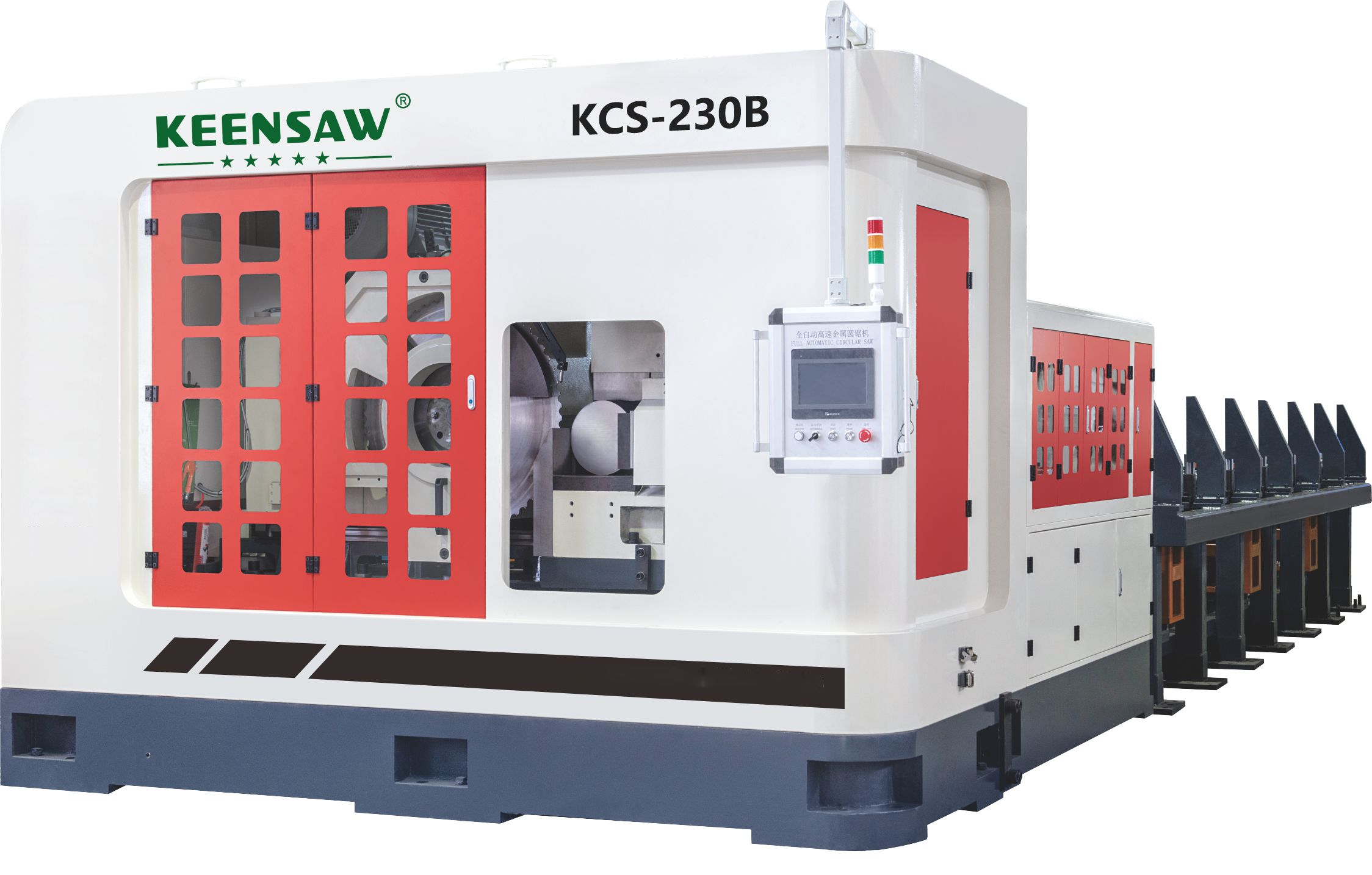
For operations demanding unrelenting output without compromising precision, the KEENSAW KCS-230B CNC Circular Saw Machine sets the industry benchmark. Specifically engineered for large-scale steel bar processing, the KCS-230B seamlessly bridges the gap between ultra-fast cycle times and optimal consumable savings.
Featuring a massive, heavily reinforced structural frame and an automated material loading bundle system, the KCS-230B allows your workshop to run completely unattended 24/7. Its intelligent CNC interface allows your team to pre-program custom parameters for diverse steel grades, automatically adjusting feeding pressures to completely eliminate the root causes of micro-chipping and blade kerf loss.
Ready to slash your consumable blade costs and multiply your factory’s tonnage output?
Q1: How do I know whether to choose a band saw or a high speed cnc circular saw machine for my workshop?
A: Band saws are optimal for structural profiles, massive blocks, and flexible miter angle cuts. However, for high-volume, continuous straight cutting of solid steel bars and heavy tubes under 230mm, a CNC circular saw delivers up to 5x faster throughput and a significantly superior surface finish.
Q2: Exactly how do I maximize tct blade life during continuous multi-shift operations?
A: Beyond using clean lubricant, you must ensure your machine maintains an unyielding feed rate. Ensure the anti-backlash mechanism in the machine gearbox is properly calibrated to eliminate sudden blade jerks when entering and exiting the metal stock.
Q3: What causes micro chipping in cermet blades compared to standard carbide?
A: Cermet tips possess extreme thermal resistance but lower fracture toughness. Micro-chipping is primarily caused by structural vibration within the machine frame or irregular material feeding cycles when cutting through hardened core structures.
Q4: Can the KEENSAW KCS-230B process bundled material automatically?
A: Yes. The KCS-230B is designed as a fully integrated automatic sawing center. It can be paired with customized automatic magazine loading systems that split, advance, securely clamp, and cut heavy raw material loads continuously with zero manual labor.
Q5: Why does machine framework weight matter for a circular saw center?
A: Heavy cast frames absorb the immense structural harmonics generated by high-RPM cutting blades. A heavier frame prevents vibrations from moving into the spindle, protecting tooth tips and saving thousands of dollars in blade costs annually.
Q6: Does a mirrored surface finish from a circular saw save processing costs?
A: Absolutely. The clean, burr-free edge delivered by the KCS-230B frequently allows parts to go straight into automated welding lines or CNC lathes, completely cutting secondary deburring or end-facing steps out of your production timeline.
Q7: What maintenance is required to protect the anti-backlash mechanism?
A: Regular inspection of gearbox fluid levels and minor gear tolerance calibrations ensure the blade never slips or stutters inside the cut, which is vital for securing stable tonnage output.
Q8: Is training specialized operators necessary for running an automatic CNC circular saw?
A: No. Advanced units feature intuitive graphic touch-screen HMIs with pre-loaded material libraries. Operators simply input the material diameter and desired cutoff lengths, and the system automatically calculates the perfect feed rate.
Q9: How does kerf loss impact long-term material ROI in mass production?
A: Industrial circular saws utilize ultra-thin blades compared to ancient heavy saws. By narrowing the kerf (cut width), you save millimeters of metal per cut. Over thousands of cuts per week, this saves tons of premium raw metal bars.
Q10: Where can I source certified technical support and custom automation loading tables?
A: As a premium full-service machinery partner, KEENSAW delivers end-to-end engineering, customized loading rack manufacturing, and comprehensive global technical support to future-proof your floor.
Contact us if you have any questions we will reply as soon aspossible