Two machines, two operators, two queues. That is the hidden tax most shops pay on every cut tube: saw it on one machine, walk it to a chamfering station, fixture it again, deburr it, then move on. The math is brutal—up to 40–50% of cycle time is non-cutting handling. An integrated automatic sawing-deburring line collapses that to one clamp, one operator, one cell.
KEENSAW is a one-stop metal cutting specialist—its own homepage promises “cutting + chamfering + drilling + marking + lathe” production lines. This guide shows B2B buyers how to architect a cutting-and-chamfering line that genuinely doubles throughput, and where the ROI really comes from.
| Step (Separate Stations) | Time Type |
|---|---|
| Load + clamp on saw | Value-add |
| Cut | Value-add |
| Unload + walk + reload on chamferer | Non-cutting handling |
| Chamfer / deburr | Value-add |
| Inspect + bin | Non-cutting handling |
On an integrated line, the chamfer happens in the same clamp the moment the cut finishes—no walk, no re-fixture, no second operator.
KEENSAW pairs these into a continuous cell:
| KEENSAW Chamfering Model | Capacity | Note |
|---|---|---|
| KCM-80SE | Ø80 mm | Pneumatic single-head |
| KCM-120SE | Ø120 mm | Hydraulic single-head |
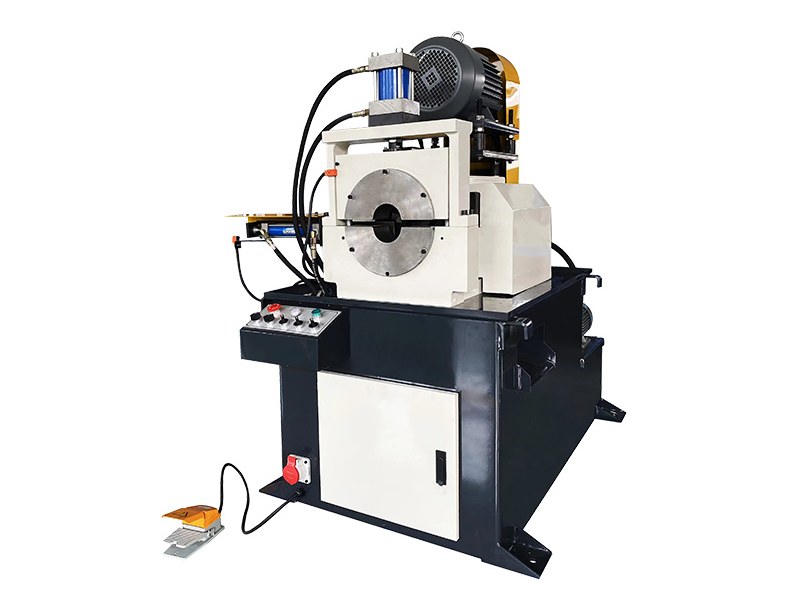
| KCM-230SE | Ø230 mm | Hydraulic pipe chamfering |
| KCM-350SE | Ø350 mm | Single-end pipe chamfering |
| Lever | Separate | Integrated Line |
|---|---|---|
| Operators | 2 | 1 |
| Re-fixturing | Yes (2x) | None |
| WIP queue | Between stations | Zero |
| Output / shift | Baseline | ~1.8–2.0x |
Buyers say “deburring” but the machine does a chamfer—a controlled bevel that removes the burr and prepares the edge for welding, fitting, or insertion. KEENSAW chamfering machines cut I/O chamfer, face, and bore in one pass, which is the production-grade answer to hand deburring.
Design your cutting + chamfering cell
KEENSAW integrates saws, chamferers, and conveyors into one throughput-doubling line.
A production cell that cuts and chamfers/deburrs a part in one clamped sequence—usually a saw feeding a chamfering machine on a shared conveyor—eliminating the walk and re-fixturing between separate stations.
By removing 40–50% non-cutting handling and one operator, a well-sized integrated line typically delivers ~1.8–2.0x the parts-per-shift of two separate stations.
Deburring removes the edge defect; chamfering is the controlled bevel that does it and also prepares the edge for welding/fitting. KEENSAW chamfering machines do I/O chamfer, face, and bore in one pass.
Depends on material and tolerance: band saw for general cut-off, CNC circular/cold saw for tight tolerance and finish, orbital cutter for thin-wall tube. KEENSAW supplies all four.
The KCM series spans Ø80 mm up to Ø350 mm, single or double head, pneumatic or hydraulic.
Yes. KEENSAW chamfering machines do external chamfer on solid bars and I/O chamfer on tubes; the saw side cuts both.
Start from peak parts/hour, then match saw cut rate, chamfer capacity, loading method, and discharge. See the 6-point checklist above.
Yes. KEENSAW’s positioning is “cutting + chamfering + drilling + marking + lathe” integrated lines, supplied as a one-stop metal cutting solution.
Labor savings (one operator vs two) plus recovered floor space usually pay back the integration premium within 12–24 months at volume.
Often yes—KEENSAW can add conveyors, loaders, and a chamfering station to an existing saw, depending on footprint and control compatibility.
Double your cut + chamfer output
One cell, one operator, zero re-fixturing. Talk to KEENSAW engineering.
Contact us if you have any questions we will reply as soon aspossible