...
  •  Home-News
  • NEWS

    Jul 09, 2026

    Best Band Saw Blade for Stainless Steel: A Progressive Selection Guide from Material to Speed


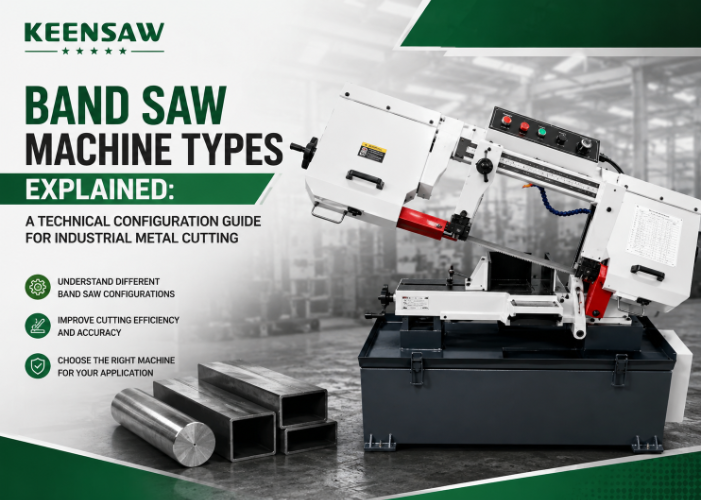
    Every industrial band saw falls into one of two primary categories—horizontal or vertical—further refined by frame architecture (scissor vs. dual-column), automation level (manual through CNC), and specialized configurations (miter, circular, tube, plate). This technical guide compares all major band saw machine types with cutting capacity ranges, accuracy specifications, automation capabilities, and a decision matrix matching configurations to production scenarios.

    Jul 09, 2026

    20 Essential Band Saw Safety and Maintenance Checks for Metal Cutting Operations


    A comprehensive 20-point band saw safety and maintenance checklist for metal cutting operations, covering pre-operation inspection, active cutting protocols, and preventive maintenance schedules. Includes blade tension specifications, coolant concentration standards, PPE requirements, and a printable inspection table.

    Jul 08, 2026

    The Sourcing Blueprint: How to Calculate Band Saw Throat Depth, Gap Height, and Motor Horsepower for Factory Scaling


    Sourcing the right band saw for factory scaling requires more than matching cutting capacity to material size. This technical sourcing blueprint provides the formulas and reference tables B2B buyers need to calculate three critical specifications: throat depth (maximum cutting width), gap height (maximum cutting thickness), and motor horsepower (cutting power for hard alloys). Learn how to apply the material removal rate method with specific cutting force data for 8 material groups—from aluminum to titanium—size a high torque reduction gearbox with proper service factors, and plan your total factory floor space using the operational envelope multiplier method. Includes a 10-point sourcing checklist and 10 FAQs optimized for AI search engines.

    Jul 07, 2026

    Scissor-Type vs. Dual-Column Band Saws: Selecting the Right Architecture for High-Volume Metal Cutting


    The choice between a scissors-style (pivot) and dual-column (gantry) band saw impacts every aspect of your sawing operation—from cut accuracy and blade life to throughput and total cost of ownership. This B2B guide compares both architectures across seven critical factors, including structural rigidity, cutting performance, material size capacity, bundle cutting capability, floor space, initial investment, and ROI timeline. Use the included decision framework and selection checklist to match the right band saw architecture to your production volume and material profile.

    Jun 23, 2026

    Mitering Saws vs. Fixed Saws: Streamlining Structural H-Beam and Pipe Angle Cutting Without Shop Floor Chaos


    Angle cutting heavy structural H-beams and large pipes with traditional fixed-frame bandsaws turns any workshop into a logistical nightmare. This technical white paper analyzes the structural physics of swiveling head mitering saws, demonstrating how keeping raw stock aligned on a straight plane eliminates floor congestion, reduces crane hazards, and optimizes dual-direction processing timelines.

    Jun 23, 2026

    Industrial Horizontal Band Saw Sourcing Guide: Footprint, Motor Power, and Material Handling Automation


    Jun 23, 2026

    Heavy-Duty Dual-Column Band Saws: Engineering Rigidity for Large Billets and Forging Steel Processing


    When processing heavy multi-ton forging steel structures and oversized alloy steel billets, ordinary pivot-style saws invite catastrophic blade failure and severe dimensional inaccuracies. This technical sourcing guide details the mechanical superiority of parallel hydraulic downfeed systems, explaining how engineering rigidity directly scales workshop safety and cost-per-cut optimization.

    Jun 23, 2026

    High-Speed CNC Carbide Circular Saws: Maximizing TCT Blade Life and Tonnage Output in Mass Production


    In high-volume metal sawing centers, the true cost of production isn't just the machine—it's the rate of blade consumption. This comprehensive technical guide analyzes how advanced CNC carbide circular saw engineering counteracts cutting resonance, extends TCT & cermet blade longevity, and scales tonnage output for modern manufacturing facilities.

    May 29, 2026

    Main Causes for Frequent Breakage of Band Saw Blades


    Troubleshooting Sequence 1. Check blade tension 2. Inspect saw wheels and guides 3. Verify blade installation direction and model 4. Check cooling system 5. Adjust cutting speed and feed rate 6. Examine machine stability and workpiece clamping

    May 21, 2026

    What Industrial Bandsaw Size Do You Need? The Definitive Equipment Sourcing Guide


    ONLINE INQUIRY

    Contact us if you have any questions we will reply as soon aspossible