A square cut is the foundation of every downstream operation—welding, machining, and assembly all assume the end face is perpendicular to the axis. A band saw that cuts a few degrees off turns a simple cutoff into a scrap part or a rework job. This guide explains what throws a cut out of square, gives you a five-step procedure, and shows how to control the burr while you are at it.
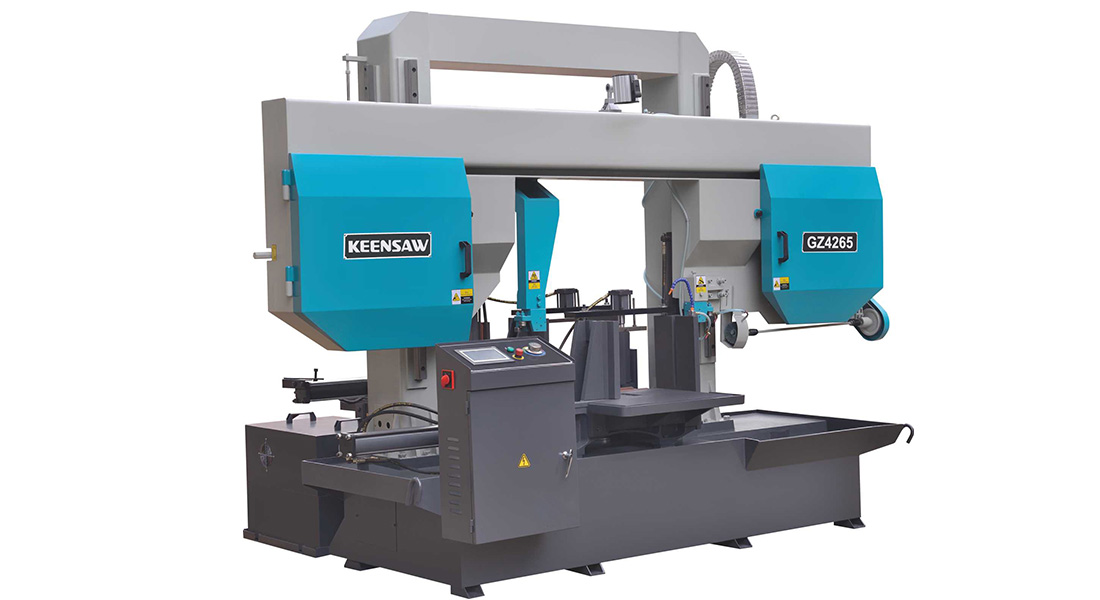
Angular error rarely comes from one big fault; it is the sum of small ones. The vise may not be square to the blade. The blade may deflect under feed because tension is low or guides are far from the cut. The feed rate may be too high, pushing the blade sideways. Chip packing in the gullets can wedge the blade off-line. And a worn guide lets the blade whip in the last millimeters. Fix all five and squareness stays within tolerance part after part.
The vise is where squareness starts. With the blade stopped and guarded, place a machinist’s square against the fixed jaw and the blade plane, and adjust the jaw (or shim) until they are true. On machines with a swivel vise, lock it at exactly 90° and verify with a dial indicator, not by eye. Re-check after any crash or heavy bundle cut—visepressure shifts over time.
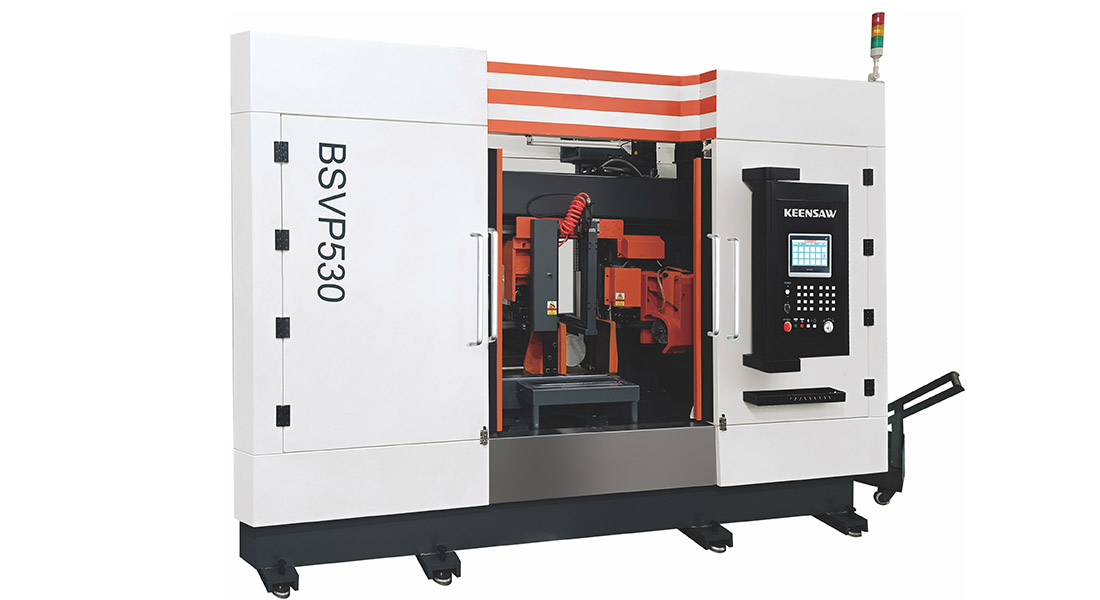
For repeat work, a fixed stop block on the feed side gives every bar the same length without re-measuring, and a back fence keeps the stock square to the blade plane. For bundles, a bundle vise and a squaring bar align all bars at once. Fixtures remove operator variation—the cheapest way to hold squareness across a shift is to make the setup repeatable, not to rely on feel.
| Method | Use |
|---|---|
| Machinist’s square + feeler | Quick shop check |
| Dial indicator on a sine bar | Tight tolerance verification |
| End-for-end butt test | Reveals angular error visibly |
| CMM / optical | Final inspection, certified parts |
Feed rate is the silent squareness killer. Too high and the blade bows into the cut, opening an angle; too low and the tooth rubs and work-hardens the face. Match feed to material and TPI, and keep it steady—a hydraulic or servo feed that sags under load will drift the cut. Blade condition matters too: a worn or wrongly set blade cuts its own angle regardless of the vise.
Every saw cut leaves a burr; the trick is to keep it small and predictable. A sharp blade at the right speed leaves a thin, uniform edge; a dull blade or wrong TPI leaves a heavy, ragged one. Flood coolant reduces the heat that welds a bigger burr. For weld-prep or handling, plan a light deburr—a file, brush, or chamfer pass—so the burr never reaches the next station. Our chamfering guide covers removing it at the saw.
| Application | Typical squareness |
|---|---|
| General cutoff | ±0.5° acceptable |
| Machining stock | ±0.2–0.3° |
| Weld-prep / structural | ±0.1–0.2° |
| Precision / aerospace | <0.1°, verified |

The vise that holds your stock is where squareness is won or lost. Hydraulic vises give consistent, high clamp force and are standard on production saws. Pneumatic vises are faster but softer, fine for light sections. Mechanical (manual screw) vises depend entirely on the operator’s effort and are the weakest link on jobbing saws. Whatever the type, the fixed jaw must be square to the blade and the movable jaw must pull the stock against the back fence, not just pinch it. A swivel vise must be locked at exactly 90° for straight cuts.
A band saw blade is a thin beam; under feed it bows slightly toward the cut, and that bow is an angle. The bow grows with low tension, far guides, high feed, and a worn blade. Close the guides to the work and the unsupported length drops, so the bow shrinks and squareness holds. Picture the last few millimeters before the cut as a cantilever—shorter and stiffer is squarer. This single idea explains most angular-error fixes.
| Method | Best for |
|---|---|
| Hand file / deburr brush | Low volume, quick edge |
| Chamfer / facing station | At the saw, weld-prep |
| Vibratory / tumble | Batches of small parts |
| CNC deburr | Precision, certified parts |
Plan the deburr with the cut, not after. A light chamfer at the saw removes the burr where it is born and gives a clean weld-prep edge; doing it later costs a handling step. Our chamfering machine guide covers in-line options.
For a weld-prep or aerospace part needing ±0.1°, the recipe is: squared hydraulic vise with a back fence, blade tension to the width table, guides within a few millimeters of the cut, correct TPI, steady servo feed, and a dial-indicator verification on the first piece. Run the batch without touching settings, and re-verify after a blade change. Squareness is then a process, not luck—and it repeats shift after shift.
A square cut is rarely the final product—it feeds welding, machining, or assembly, and each downstream step assumes the face is perpendicular. A 0.5° error that looks trivial at the saw becomes a gap at a weld joint or a setup shim at a mill. Cutting square the first time removes a rework step and a handling step; cutting out of square pushes the cost downstream where it is harder to see. When you size a saw for a line, weigh squareness capability against the tolerance the next station demands, not against the saw’s catalog claim alone.
| If the cut is… | Check |
|---|---|
| Off on every piece | Vise squareness, fixed jaw |
| Off only on bundles | Bundle vise, squaring bar |
| Drifts during a run | Tension, guide wear, feed sag |
| Off after a blade change | Blade defect, break-in, tracking |
| Off on one material | TPI/feed mismatch for that alloy |
Work the table top to bottom: a constant angle is the vise; a drifting angle is setup wear; an angle that appears after a change is the blade or break-in. Isolating by pattern turns a vague complaint into a ten-minute fix.
Follow this and squareness becomes a process you can repeat shift after shift, not a luck-of-the-draw result.
Cuts coming out angled or burred? Contact KEENSAW with your material and tolerance. We’ll recommend blade, feed, and guide settings—plus fixtures and stop blocks—to hold squareness across your whole batch.
Contact us if you have any questions we will reply as soon aspossible