A band saw blade does not fail all at once—it warns you for days. Reading those warnings and changing the blade on time is the difference between a planned five-minute swap and a snapped blade that scars a billet and stops the line. This guide lists the seven signs, explains the failure modes behind them, and shows why waiting is almost always the expensive option.

| Mode | Cause | What you see |
|---|---|---|
| Tooth wear | Normal abrasion | Slow cut, burn, rough face |
| Tooth strip | Wrong TPI / overload | Missing teeth, chatter |
| Gullet crack | Over-tension / hard spots | Cracks at tooth root |
| Weld fatigue | Over-tension / poor weld | Snap at the join |
| Set loss | Side load / guiding | Wavy cut, binding |
Before you condemn a blade, look at it with the machine stopped and guarded. Run a finger (carefully, with a rag) along the teeth—rounded or broken tips are obvious. Check the gullets for cracks and the weld for a hairline. A blade with life left can often be saved by correcting feed, TPI, or coolant; a blade with missing teeth or a cracked gullet is done. Inspecting takes a minute and prevents throwing away a good blade.
A new blade needs a short run-in: cut the first few pieces at reduced feed so the tooth tips seat evenly. Skipping run-in overloads the very tips that set the finish and can strip them on hard material. After run-in, raise feed to normal. This simple step noticeably extends blade life and stabilizes the first cuts of every blade.
Blades are precision tools, not rope. Store them coiled, supported, and dry—never hung over a nail or left on a damp floor where they rust between the teeth. Handle with gloves; a fingermark on a fresh M51 edge can start corrosion. Coil and uncoil along the natural radius to avoid kinking the back edge, which is a hidden cause of early weld failure.
Waiting is rarely cheaper. A dull blade cuts slower, so you lose throughput on every remaining part. It runs hotter, so coolant and finish suffer. It loads unevenly, so it can snap and scar an expensive billet. And it hides the real problem—wrong TPI or feed—that also shortens the next blade. A planned change costs one blade and five minutes; an unplanned snap can cost a part, a shift, and a weld repair.
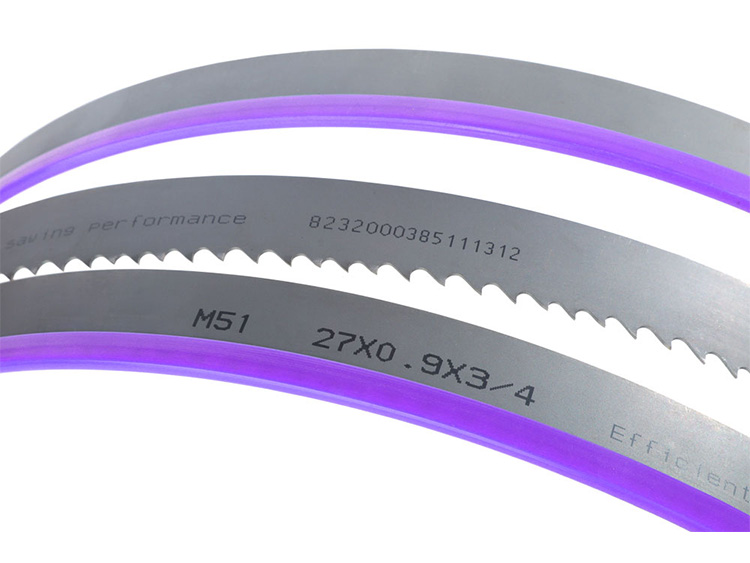
| Material | Replacement blade |
|---|---|
| Carbon / alloy steel | M42 bi-metal, 4–6 TPI |
| Stainless / abrasive | M51 or carbide-tipped |
| High-strength / exotic | Carbide or cermet |
| Aluminum / non-ferrous | Bi-metal, hook/skip tooth |
| Duty | Change when… |
|---|---|
| Light jobbing | Cut quality drops or signs appear |
| Production steel | Per piece count target, not calendar |
| Stainless / exotic | At first burn or rough face |
| Bundle / structural | Per bundle count or sign 2–3 |
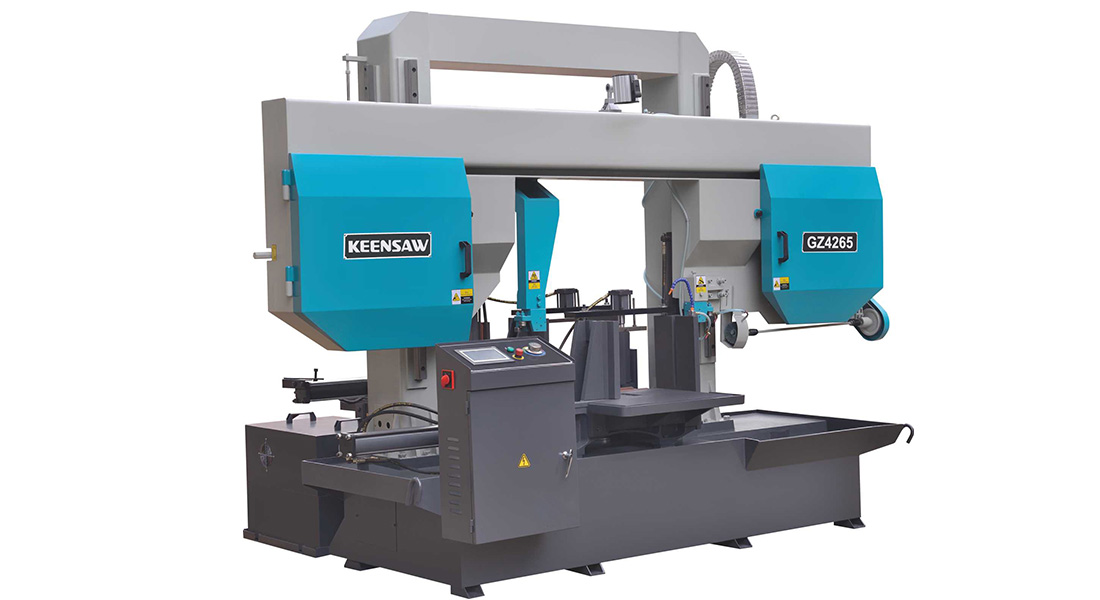
Knowing the parts helps you read failure. The tooth tip does the cutting and shows wear first. The gullet clears the chip; cracks here are fatigue, not abuse. The set (side offset) gives kerf width—lose it on one side and the cut wanders. The back edge carries tension; a kink here is a hidden snap waiting to happen. The weld joins the loop; it is the most stressed point and the usual failure site when over-tensioned. Inspect each part and the warning sign tells you the cause.
| Choice | Cost | Risk |
|---|---|---|
| Planned change at sign 1–4 | One blade, 5 min | Low |
| Wait for sign 7 (snap) | Blade + scrapped part + downtime | High |
| Run dull, no change | Slow cut + poor finish all shift | Medium |
The planned change is almost always cheapest. The “wait and see” approach only looks free until the blade snaps in an expensive billet or the line stops for an hour. Track pieces per blade and you will see the optimum change point instead of guessing.
Most “blade problems” are setup problems. Correct TPI for the section, right tension for the width, flood coolant at strength, guides close to the cut, and a short break-in—together these routinely double life. Before you blame the blade brand, confirm those five. Shops that manage them buy far fewer blades per month and complain far less about wandering cuts.
Used steel and carbide-tipped blades are recyclable metal, not trash. Coil them, keep them dry, and sell or return them with other shop scrap. Carbide blades in particular have recoverable value in the tooth tips. A small bin by the saw turns a disposal cost into a minor recover, and keeps the floor safe from loose coiled blades.
| Grade | Best for | Trade-off |
|---|---|---|
| M42 bi-metal | General carbon/alloy steel | Lowest cost, shorter life on abrasive |
| M51 bi-metal | Stainless, abrasive alloys | More wear resistance, higher price |
| Carbide-tipped | Exotic, high-strength, volume | Highest life/speed, premium cost |
| Cermet | Very hard alloys | Brittle, needs rigid setup |
The grade is not “better vs worse”—it is matched to the alloy and the duty. Buying M51 for mild steel wastes money; buying M42 for stainless wastes blades. Match grade to your hardest common material and step down for the easy stuff.
Track per blade: date in, material, section, TPI, grade, pieces cut, failure sign, date out. Over a month the log shows your real pieces-per-blade by material, exposes a bad setup (life suddenly drops), and tells purchasing exactly what to stock. It turns blade buying from guesswork into a number you can quote to finance. Even a spreadsheet on the shop tablet beats the usual “grab whatever is on the rack” approach that hides thousands in lost blade life a year.
This checklist turns blade changes from a panic into a planned, five-minute task that protects parts and throughput.
Buying blades by the piece is costing you money. Ask KEENSAW for a blade program matched to your material and volume—correct grade, TPI, and change interval to maximize pieces per blade.
Contact us if you have any questions we will reply as soon aspossible