Both horizontal and vertical band saws share the same blade and the same cutting principle—but the way the blade meets the work decides almost everything about what each machine is good at. This guide explains how each type works, puts them head to head on the numbers that matter, and gives you a decision table you can hand to procurement.
In a horizontal machine the blade runs in a loop over the top of the stock and the head descends under gravity or hydraulics while the bar sits still in a vise. The cut is a straight down-feed, so the force path is simple and rigid. That is why horizontals own straight cutoff of bars, tubes, and bundles. On CNC models the vise opens, the bar indexes to length, the head drops, and the piece drops into a cradle—all unattended. The 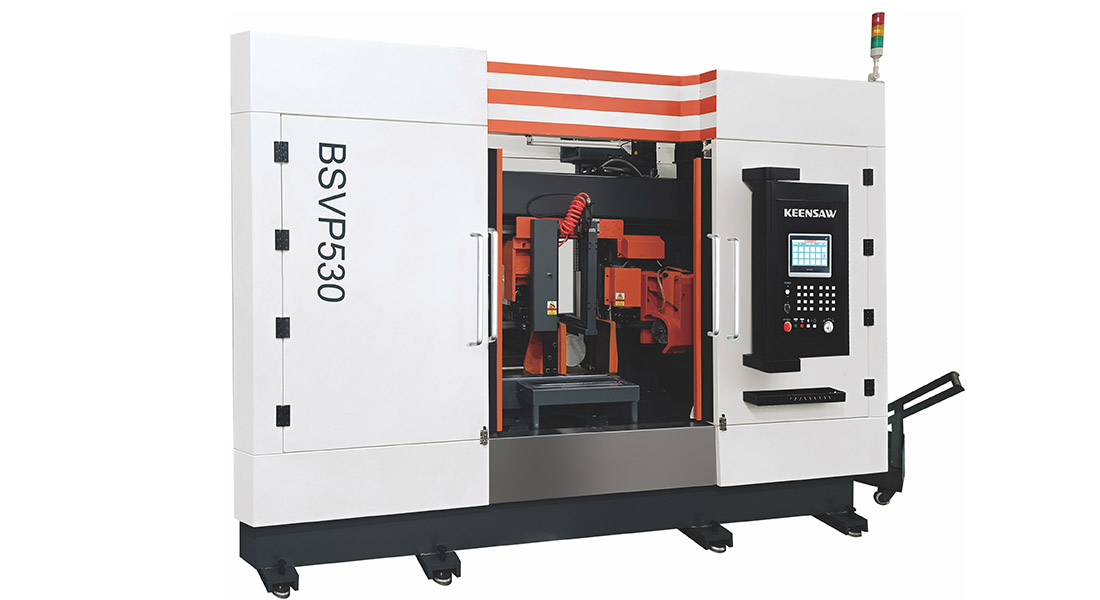 BSVP530CNC is a good example of a high-speed automatic horizontal built for volume.
In a vertical machine the table is horizontal and the blade runs straight down through it. The operator (or an NC table) feeds the stock into the blade, which means you can steer the work to cut curves, contours, and internal profiles. Because there is no descending head, the workpiece is fully accessible from above. The 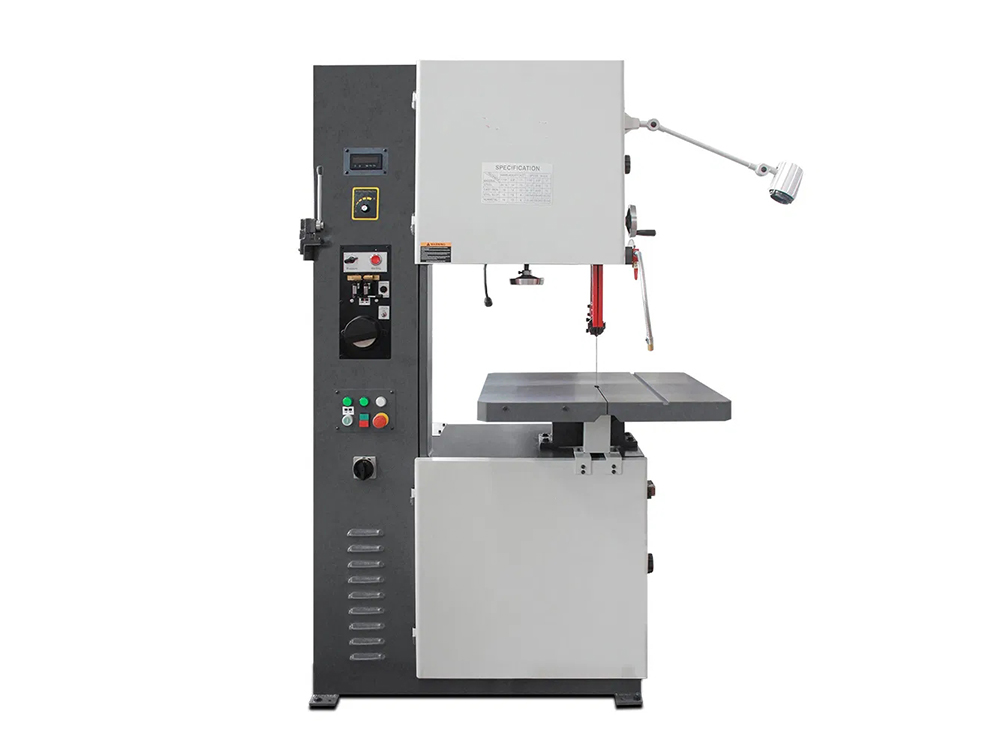 L-33/58S vertical band saw with tilting table and the G5350 are typical contour and profile cutters.
| Factor | Horizontal | Vertical |
|---|---|---|
| Primary motion | Blade descends onto fixed stock | Stock fed into fixed vertical blade |
| Best cut type | Straight cutoff to length | Curves, contours, internal cuts |
| Automation | Excellent—auto index, bundle | Limited—manual or NC table |
| Operator attention | Low (unattended cycles) | High (hands on the work) |
| Footprint | Larger (head travel) | Compact (table only) |
| Typical work | Bars, tubes, billets, bundles | Plate, profiles, forgings, shapes |
For any shop whose dominant job is “cut this bar to length, 500 times a day,” the horizontal is unbeatable. Its rigid down-feed and automatic indexing let one operator run several machines. Dual-column and gantry horizontals scale to 1,000 mm+ rounds and billets. Bundle vises let you cut a whole cage of bars in one pass. If throughput and labor cost matter, the horizontal is the answer.
When the part has a shape—a bracket profile, an internal slot, a curved gasket, a stack of plates with a contour—only a vertical can cut it without a mill or a laser. The tilting table versions add angle work; the movable-table versions handle long or heavy plates. Verticals also shine at short, one-off, and prototype cutting where setting up an auto horizontal is not worth it.
| Type | Representative KEENSAW model | Capacity note |
|---|---|---|
| Horizontal CNC | BSVP530CNC | High-speed bar cutoff |
| Horizontal auto | GZ4232 | General bar and tube |
| Vertical contour | L-33/58S | Tilting table profiles |
| Vertical industrial | G5350 | Larger plates and shapes |
Horizontals cost more up front for CNC and bundle options, but they save labor every shift and drop straight into a cutoff line ahead of a machining cell. Verticals are cheaper and smaller, but they are manual labor per cut. If you are building an automated line, the horizontal (or a rotary/circular cutoff) is the cutoff station; the vertical stays as a flexible backup for shaped work. Many shops run both—a bank of horizontals for production and one vertical for everything odd.
| If your work is mostly… | Choose |
|---|---|
| Straight bar/tube cutoff, high volume | Horizontal (CNC) |
| Billets and large solid sections | Dual-column / gantry horizontal |
| Contours, internal cuts, plates | Vertical |
| One-offs, prototypes, odd shapes | Vertical |
| Structural and pipe at angles | Miter / swivel (horizontal or vertical head) |
On a CNC horizontal the “straight cutoff” job becomes a repeating loop the operator only sets up once. The control stores cut length, quantity, feed pressure, and surface speed. The vise releases, a servo or hydraulic indexer pushes the bar to the stop, the vise clamps, the head descends at the programmed feed, the blade cuts, the head rises, the cut piece drops onto a cradle or conveyor, and the cycle repeats until the batch count is met. The operator tends several machines, changes bundles, and handles exceptions. This is why horizontals dominate production: the labor per cut approaches zero while the machine runs.
Verticals are not helplessly manual. An NC or CNC table adds powered X/Y movement so you can cut a programmed contour—radii, notches, and repeating profiles—without steering by hand. For low-volume shaped parts this closes much of the gap with a horizontal’s automation, though it still needs an operator at the table. The trade is footprint and cost: an NC vertical is compact and cheap next to a full contour laser, which is why jobbing shops keep one.
| Quality factor | Horizontal | Vertical |
|---|---|---|
| Straight-cut squareness | Excellent (fixed vise) | Operator-dependent |
| Surface finish | Good (correct TPI) | Good on contour |
| Heat affected zone | Minimal (flood coolant) | Minimal |
| Contour capability | None | Excellent |
For straight cutoff the horizontal is simply more repeatable, because the vise and down-feed are rigid and the operator is not in the force path. The vertical wins on any part with a shape, where squareness is set by the table, not a vise.
A common, cost-effective layout is a bank of two to four CNC horizontals for daily bar and tube cutoff feeding a machining cell, plus one vertical for shaped, prototype, and odd-lot work that is not worth setting up the horizontals for. Add a miter/swivel saw for structural angles and you cover essentially every cutoff the average fabricator sees. Specifying this mix up front avoids buying one oversized machine that is wrong for half the work.
For structural steel, pipe joints, and framework you often need an angle, not a square end. A miter or swivel band saw pivots the head or vise so you cut the angle without rotating the stock—cleaner and safer than tilting a heavy bar in a standard machine, and far more accurate than a freehand grind. The G4028Z60 (0–60°) and the PX-35/65N NC miter saw are typical examples. They sit between horizontal and vertical: straight enough for production runs, angled for fabrication. If a large share of your work is structural or pipe at angles, a dedicated miter saw earns its floor space beside the horizontals rather than making operators fight a standard machine into a job it was not built for.
Choosing the type is also a money decision, not just a capability one. A horizontal CNC costs more up front but removes labor per cut and scales with volume; a vertical is cheap and compact but stays manual, so its cost is operator time on every piece. Add blades, coolant, floor space, and the scrap from mis-cut parts, and the horizontal usually wins on pure throughput while the vertical wins on flexibility for low-volume shaped work. The right mix—two or three horizontals for the daily bar count plus one vertical for contours—minimizes both labor and capital tied up. Model your actual cut count and mix before buying; the answer lives in your volume, not a catalog page.
Still deciding between horizontal and vertical? Tell KEENSAW your typical section, material, and daily cut count. We’ll recommend the machine type, capacity, and automation level that fits your shop—and quote a horizontal, vertical, or both.
Contact us if you have any questions we will reply as soon aspossible