Length drift and a heavy burr rarely come from one broken part. On a tube cutting machine they come from six variables working against each other: clamp pressure, blade condition, feed rate, material support, stopper repeatability, and chip evacuation. Fix them in the right order and you can hold tight tolerance without buying new equipment. This guide walks you through the variables one at a time, gives you a setup check you can run in fifteen minutes, and shows you where the physical limit of the machine really sits.
Every out-of-tolerance cut you pull off the conveyor can be traced back to one of these six. Work through them in order, because a clamp problem will hide a blade problem, and a blade problem will hide a feed problem.
The vise is the reference for everything else. If the clamp does not hold the tube rigidly, the blade pulls the tube forward by a few hundredths of a millimetre on every stroke and your length drifts in one direction. Check three things: jaw wear (a polished or dished face means replacement), clamp pressure against wall thickness, and jaw alignment after a crash. Thin-wall tube needs lower pressure spread over a longer jaw; heavy-wall tube needs high pressure and a clean, flat seat. Hydraulic clamping with a pressure gauge you can actually read is worth more than a bigger motor.
A dull blade does not simply cut slower. It rubs, work-hardens the cut zone, and pushes the tube instead of shearing it. That shows up as a burr that grows over a shift and a cut face that starts to shine instead of showing clean machining marks. Look for a wear land on the tooth tip, chipped carbide corners, or a blade that has lost tension. On carbide saws a single chipped tooth is enough to double burr height.
Feed rate and wall thickness have to move together. A feed that is correct for 4 mm wall will crush 1.5 mm wall and leave a rolled-over burr on the exit side, while a feed that is gentle enough for thin wall will glaze the blade on thick wall and burn through tool life. Set the feed from the wall, then trim it by watching the chip: a good chip is a comma shape, not dust and not a long spiral ribbon.
A 6 m tube hanging past the clamp acts as a cantilever. It rings, it drops as the cut completes, and it lifts the cut face out of square. Roller supports set within 300 mm of the vise, plus a bundle support if you cut stacked tubes, remove most of the vibration. If your cut face is square on short pieces and angled on long ones, the support is the first thing to fix.
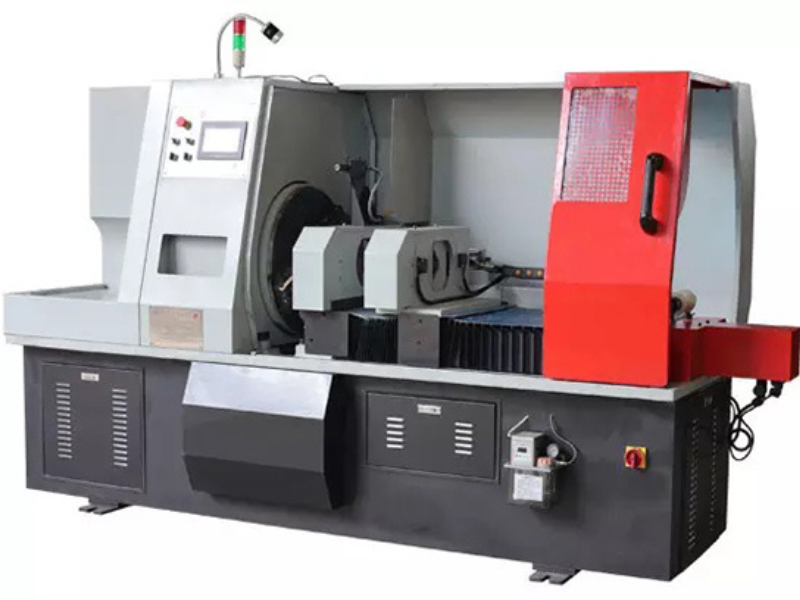
Length accuracy is a function of the feed system, not the blade. Servo feed with a ball screw holds far tighter than a hydraulic stop, and it lets you set the tailing length so you are not cutting a stub every bar. On a servo-fed machine, backlash in the ball screw and a loose encoder coupling are the two most common causes of progressive length drift. The KTC-425NC-A, for example, is rated at ±0.15 mm with a 1000 mm single-stroke servo feed that can index multiple times.
Chips that stay in the kerf get recut, and recut chips are what produce the torn edge you see under a magnifier. Flood coolant aimed at the entry side, a chip brush that still touches the blade gullets, and a conveyor that is not packed solid will fix more burr problems than a blade change. Check the brush weekly; it is the cheapest part on the machine and the most often ignored.
Use this table when a machine that used to be good starts drifting. Read from the symptom, not from the setting you suspect.
| Symptom | Most likely cause | What to do first |
|---|---|---|
| Length drifts in one direction over a shift | Tube slipping in the clamp, or stopper wear | Clean jaws, check clamp pressure, inspect stopper face |
| Cut face square on short tube, angled on long tube | Cantilever vibration | Add or reposition roller support near the vise |
| Burr grows during the shift, noise rises | Blade wear land or chipped tooth | Inspect tooth tips, swap or sharpen the blade |
| Burr only on the exit side, wall looks rolled | Feed too high for the wall | Reduce feed 20% and re-check chip shape |
| Random long or short pieces, no pattern | Servo backlash, loose coupling, or encoder fault | Check coupling, then verify feed against a dial indicator |
| Blue or brown discolouration on the cut face | Heat: low coolant flow or wrong speed | Restore coolant flow, drop spindle speed one step |
Burr is not a pass or fail number on its own. It is a function of what happens after the saw. Measure the burr with a deburred comparator or a profile projector, take three readings around the circumference, and judge against the next operation rather than against a shop-floor habit.
| Next process | Target burr height | Why |
|---|---|---|
| Orbital or laser welding | Under 0.10 mm, no roll-over | Burr disturbs arc stability and gas coverage |
| Manual TIG welding | Under 0.20 mm | Burr melts into the pool and can create porosity |
| Chamfering or end forming next | Under 0.50 mm | The next station removes it anyway |
| Visible cosmetic part | Deburr to touch, no measurable burr | Handling and coating defects |
If you are cutting to a tolerance tighter than ±0.10 mm on length, you are already in servo-feed territory and the saw has to be rigid enough to hold it. That is where machine choice starts to matter more than operator skill.
Cutting tube from 10 mm to 130 mm and need ±0.15 mm length?
The KTC-425NC-A runs a 350-425 mm carbide blade on a servo feed with a universal left-right vise, and holds 6 mm wall without crushing it. Tell us your tube OD, wall, length and hourly output and we will confirm the model in one reply.
There is a point where no amount of tuning will get you there. If the tube is thin-walled and you are cutting under 2 mm wall at high volume, a conventional cold saw will always fight you on deformation, and a rotary tube cutter is the right answer. If the diameter is small and the volume is high, a machine with a smaller blade and a shorter stroke will out-cut a large one because the cycle time is dominated by the head travel, not the blade.
Compare your requirement with the machine class rather than the model number. The circular cold saw range covers tube from small hydraulic-feed models such as the KTC-315NC up to 130 mm capacity machines. If your problem is wall collapse rather than length, read how rotary tube cutting handles thin wall before you spend money on a bigger saw.
What length tolerance is realistic on an automatic tube cutting machine?
On a servo-fed cold saw with a rigid stopper, ±0.10 to ±0.15 mm is a normal production figure. Hydraulic-feed machines with a mechanical stop typically sit around ±0.3 mm once the stop starts to wear, so if your print calls for ±0.1 mm, specify the feed type before you compare prices.
Why does cut length drift only on the last few pieces of a bar?
That is almost always tailing-length behaviour. When the remaining bar is shorter than the clamp can hold safely, the tube tips slightly and the last cuts run long or short. Set the tailing length parameter so the machine stops with enough stock in the vise, and accept a planned remnant instead of a rejected part.
Does coolant concentration change burr height?
Yes, indirectly. Too lean a mix raises friction and heat at the tooth tip, the edge dulls faster, and burr climbs within a shift. Keep the mix at the saw maker’s recommendation and check it with a refractometer weekly rather than topping up with water.
Can one blade cut both carbon steel and stainless tube?
A carbide blade can, but the edge geometry and coating that suits mild steel is not the one that suits 304 or 316. In practice you lose tool life on stainless and pick up smearing on mild steel. Keep a dedicated blade per material family and label it; the changeover takes minutes and pays for itself in edge quality.
How do I confirm the vise is causing an angled cut?
Clamp a known-straight, thick-wall tube, cut it, then measure squareness at four points. Rotate the same tube 90 degrees in the vise and cut again. If the high side follows the rotation, the jaws or the vise seat are out; if it stays in the same place, the problem is the head or the blade path.
Why do thin-wall tubes ovalise even at low clamp pressure?
Because point contact concentrates force. Standard jaws touch the tube on a narrow band, so 1.5 mm wall deforms before the tube is actually held. Profile jaws, or jaws with a soft insert machined to the tube OD, spread the load and let you use enough pressure to stop slip without marking the surface.
How often should the chip brush be replaced?
Inspect it every week and replace it when the bristles no longer reach the gullet floor. A worn brush leaves packed chips that get recut, which shows up as a rough cut face long before the blade is actually worn out.
Is a carbide blade worth it below 30 mm diameter?
Usually not on its own, but it becomes worth it when you cut high volumes of the same diameter and want to skip deburring. The economics depend on blade cost per cut, not blade price. If you cut under about 2,000 pieces a month, an HSS blade on a rigid machine often wins.
What should I have ready before asking for a machine quote?
Tube OD and wall range, material grade, finished cut length and tolerance, burr or squareness requirement, pieces per hour, and what happens to the part after cutting. Those six answers decide the model, the blade and the automation level far more than the budget does.
Will adding a deburring station fix a tolerance problem?
No. Deburring changes the edge, not the length or the squareness. If you are out of tolerance, adding a brush or chamfer station just hides the symptom on the edge while the real error moves downstream to welding or assembly.
Keep reading
Two guides that pair with this one: how to choose a machine when cutting tubes, and the five-step method to eliminate angular error and burr from a cut.
Equipment
Start with the KTC-425NC-A for servo-fed tube cutting, or compare the full circular cold saw range.
Accuracy on a tube cutting machine is a system result, not a single setting. Fix the clamp and the support first, then the blade, then the feed. Nine times out of ten the tolerance comes back without a single purchase order. When it does not, the limit is mechanical and no amount of tuning will pass it, so it is time to match the machine to the tube instead of fighting the tube with the machine. Send us your OD, wall, length and hourly target and we will tell you which side of that line you are on.
Contact us if you have any questions we will reply as soon aspossible