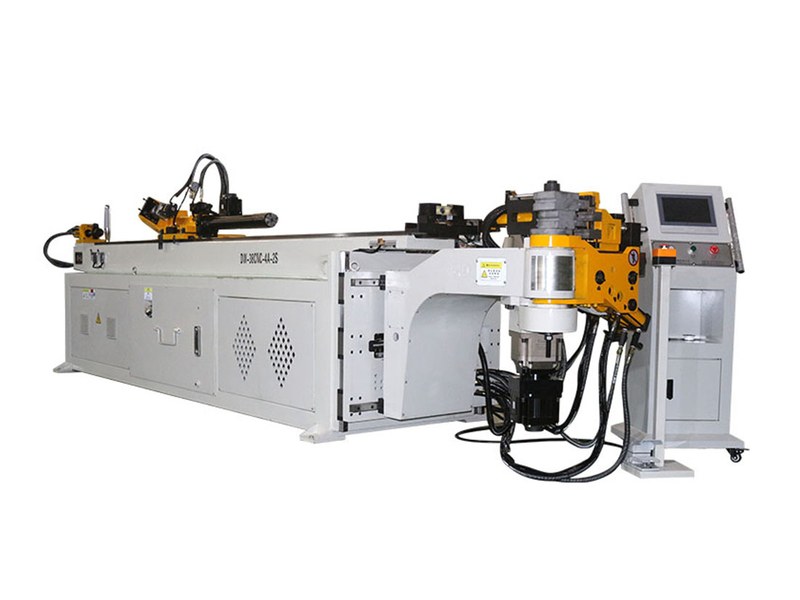
A tight-radius bend that wrinkles on the inside and goes paper-thin on the outside is not a “bad tube”—it is a process failure. In automotive brake lines and HVAC refrigerant coils, that failure means leaks, rejected batches, and warranty claims. The remedy is a properly specified mandrel tube bending machine—one where the mandrel, booster, and pressure-die assist work together to hold the wall where it belongs.
KEENSAW builds 4-axis CNC benders with booster bending and automatic mandrel lubrication, shipped to 40+ countries under ISO 9001:2016 + CE. This 101 covers the physics, the tooling, and the setup rules that stop wrinkles and wall thinning before they start.
Two defects dominate tight-radius bending:
| Defect | Where | Root Cause |
|---|---|---|
| Wrinkling | Inside of bend | Poor mandrel support, high wall-factor |
| Wall thinning | Outside of bend | Over-fast boost, no PDA |
| Ovality | Cross-section | No wiper die, weak clamp |
A mandrel is a steel rod inserted into the tube during bending. It supports the inner wall so it cannot buckle. KEENSAW’s CNC benders carry mandrels up to 2,500 mm long with automatic lubrication—critical for thin-wall stainless and aluminum.
| Mandrel Type | Use Case |
|---|---|
| Plug (ball) | Standard bends, wall-factor ~15–40 |
| Formed-tip | Average radius, heavier walls, precise support |
| Inserted-ball | High-volume, replaceable nosepiece |
| Thin-wall (close-pitch) | Wall-factor 70+, tight radius |
As the tube bends, the outside wall must be fed material to avoid stretching thin. The booster pushes the tube axially in sync with the bend; the pressure-die assist holds the tangent and prevents the wall from lifting. KEENSAW’s booster models (e.g. DW-38CNC-4A-2S+B) add a 2 kW servo booster exactly for this.
| Component | What It Controls |
|---|---|
| Mandrel | Inner-wall support → no wrinkle |
| Booster | Axial feed → no wall thinning |
| Pressure-die assist (PDA) | Tangent hold → no lift / ovality |
| Wiper die | Inside follow → smooth inner radius |
| Specification | Value |
|---|---|
| Max bending dia (carbon steel) | 38.1 × 2.0 mm |
| Max bending dia (stainless) | 32 × 1.8 mm |
| Bending radius | 250 mm |
| Axes | 4 electric (feed / rotate / bend / shift) |
| Max mandrel length | 2500 mm (auto lubrication) |
| Booster servo | 2 kW |
| Bending angle / accuracy | 0–190° / ±0.1° |
| Control | PLC + touch screen, self-diagnostic |
KEENSAW’s pipe bender family spans Ø38.1–88.9 mm across 9 CNC and NC-hydraulic models—see the full pipe bending machine category.
Wall factor = Centerline radius ÷ tube OD. As a rule of thumb:
Stop scrapping tight-radius bends
Send KEENSAW your tube sample and bend radius—we’ll spec the mandrel + booster setup.
A bender that inserts a mandrel into the tube during the bend to support the inner wall and prevent wrinkling and collapse, especially on tight radii and thin walls.
Use the correct mandrel type, position it ~1 wall thickness past the tangent, add a wiper die, and keep clamp/pressure-die pressure adequate. Lower the wall factor and wrinkles appear—so tooling must step up.
The outside wall stretches during bending. A booster feeding material axially plus pressure-die assist keeps stretch within limits. Controlled bend speed is the key variable.
Centerline radius ÷ tube OD. Below ~1.5 you need mandrel + booster + PDA; above ~2–3 a mandrel may be optional.
It pushes the tube axially in sync with the bend to feed material into the stretching outer wall, preventing wall thinning and springback on thin-wall tubes.
Yes. The DW-38CNC-4A-2S+B bends stainless up to Ø32 × 1.8 mm with mandrel support and automatic lubrication to avoid galling.
CNC uses servo axes for ±0.1° repeatability and recipe storage; NC hydraulic is lower-cost, operator-set, suited to simpler repeat parts.
Generally a centerline radius under ~2× the tube OD (wall factor < 2). These need full mandrel + booster tooling.
Bending angle ±0.1°, feed ±0.1 mm, rotation ±0.1°—PLC controlled with self-diagnostic system.
From Ø38.1 mm up to Ø88.9 mm across 9 CNC and NC-hydraulic models, covering automotive, HVAC, and furniture tubing.
Spec the right mandrel + booster bend cell
KEENSAW engineers tune tooling to your exact radius and material.
Contact us if you have any questions we will reply as soon aspossible