Walk into any metal service center, forge shop, or structural fabrication facility, and you will find band saws quietly handling the heaviest work on the floor. Yet despite their ubiquity, no two facilities use the same machine configuration. A steel service center cutting 500 mm solid billets of Inconel needs a fundamentally different saw than a job shop mitering 100 mm structural tubes at 45 degrees. Choosing the wrong configuration does not just slow production — it destroys blades, compromises cut quality, and erodes margins on every part that comes off the line.
This guide breaks down every major band saw machine type used in industrial metal cutting today. Rather than a surface-level overview, each section includes structural design principles, typical cutting capacity ranges, automation capabilities, and specific application scenarios. A master comparison table and a decision matrix at the end consolidate the technical data into an actionable format for procurement managers, plant engineers, and production supervisors evaluating their next capital equipment purchase.
Whether you are sourcing an automatic shuttle feed band saw machine for lights-out production or a semi-automatic band saw for mixed-batch job shop work, the configuration taxonomy below will help you match machine architecture to your production reality.
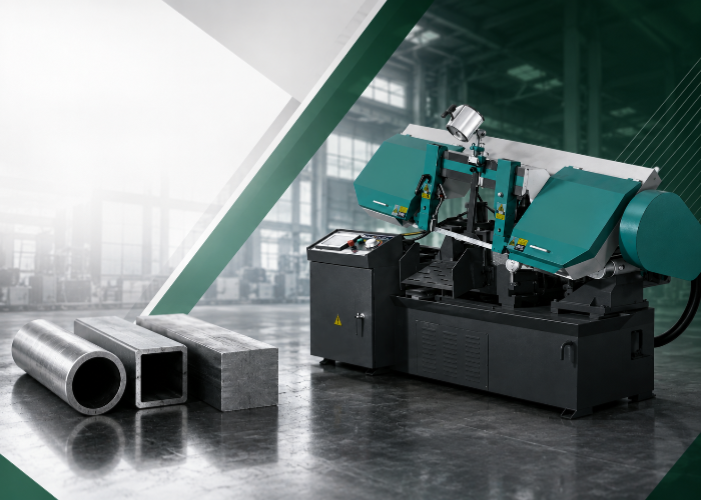
Every industrial band saw falls into one of two primary categories based on blade orientation: horizontal or vertical. This single design choice determines what materials the machine can process efficiently, what cutting operations it can perform, and how it integrates into a production workflow.
On a horizontal band saw, the workpiece is clamped stationary on a bed while the saw frame — carrying the blade loop between two wheels — descends vertically to feed the blade through the material. The blade travels horizontally through the cut, applying downward force via gravity, hydraulic cylinders, or ball-screw feed systems.
Structural Characteristics:
Advantages:
Typical Applications: Steel service centers cutting merchant bar stock to length; forge shops cutting billets; structural fabricators cutting beams and channels; tube mills cutting welded pipe; and high-volume production of precision-cut components from solid stock. For a deeper analysis of horizontal band saw sourcing criteria including footprint and motor power, see our horizontal band saw sourcing blueprint.
On a vertical band saw, the blade runs vertically through a fixed horizontal table. The workpiece is manually or mechanically fed into the blade by the operator, who controls the feed rate and cutting direction by guiding the material along the table surface. This configuration sacrifices the automation potential of horizontal saws in exchange for cutting flexibility.
Structural Characteristics:
Advantages:
Typical Applications: Tool and die shops cutting complex profiles; maintenance departments trimming castings and forgings; fabrication shops notch-cutting structural plates; and prototype shops requiring contour cuts on sheet and plate stock.
Within the horizontal band saw category, the mechanism that lowers the saw head onto the material creates a critical engineering distinction. Two architectures dominate the market: scissor-style (pivot) and dual-column. This single design difference impacts rigidity, cutting accuracy, blade life, and maximum material capacity.
A scissor-style saw head is hinged at one end of the frame, allowing the entire saw assembly to swing downward in an arc — similar to the motion of scissors. The blade enters the material at a continuously changing angle as the head descends.
Key Attributes:
The GW4028A scissor-style horizontal band saw exemplifies this category, offering semi-automatic operation with miter cutting capability in a compact footprint.
A dual-column machine mounts the saw head on two rigid vertical guide pillars. The head travels straight down and up via hydraulic cylinders or precision ball screws, maintaining perfect parallelism with the worktable throughout the cutting stroke. The blade enters the material at a constant, uniform angle across the entire width of the cut.
Key Attributes:
For a comprehensive engineering comparison of these two architectures, see our detailed guide on scissor-type vs. dual-column band saw selection. The heavy-duty dual-column band saw guide covers rigidity engineering for large billets in greater depth.
Engineering Insight: The dual-column design’s advantage is not just about cutting larger material. The parallel descent eliminates the angular force component that causes blade twist in pivot-style saws. This means that even on materials within a pivot saw’s capacity range, a dual-column machine will produce straighter cuts and longer blade life — a critical factor when cutting expensive alloys where a scrapped billet can cost more than the blade itself.
Explore KEENSAW Band Saw Configurations
Independent of the horizontal/vertical and scissor/dual-column distinctions, band saws are classified by their level of automation. This determines operator involvement, production volume capability, and per-part cost. Understanding the four automation tiers is essential for matching machine capability to production demand.
The operator performs every step: load material, set cut length manually using a scale or stop, clamp the vise, lower the saw head by hand or via a simple hydraulic lever, and unload the cut piece. No automated cycle control exists.
The operator manually loads material and sets the cut length, then presses a button to initiate the automated cutting cycle. The machine clamps the vise, lowers the saw head at a controlled feed rate, completes the cut, and raises the head back to the start position. The operator must manually unload the cut piece and reposition the material for the next cut.
The GZ4252 semi-automatic band saw and GZ4270 horizontal band saw represent this tier with hydraulic clamping and controlled downfeed.
The operator loads a bundle of material into an infeed magazine or conveyor and programs a single cut length and quantity. The machine then automatically feeds, measures, clamps, cuts, and unloads each piece without operator intervention. Some models can run unattended for hours, enabling lights-out production.
The 530BCNC automatic band saw exemplifies this tier with servo-driven shuttle feed and programmable cutting parameters.
A CNC (Computer Numerical Control) band saw manages every aspect of the cutting process through a programmable controller. Unlike a fully automatic saw that runs a single fixed program, a CNC saw can store and execute unlimited cutting programs, switching between different lengths, quantities, and even cutting parameters (blade speed, feed rate) on the fly. Servo-driven feed systems achieve positioning accuracy of ±0.05 mm, and advanced models offer remnant management to optimize material yield.
The BSV7050CNC ultra-high-speed CNC band saw represents the top tier with closed-loop motor load feedback and automatic feed rate adjustment.
| Feature | Manual | Semi-Automatic | Fully Automatic | CNC |
|---|---|---|---|---|
| Operator Role | Full manual operation | Load, set length, start cycle, unload | Load bundle, monitor | Load bundle, select program, monitor |
| Measuring | Manual (scale/stop) | Manual (digital readout) | Automatic (fixed length) | Servo-driven, programmable (±0.05 mm) |
| Feeding | Manual | Manual | Automatic (shuttle feed) | CNC servo ball-screw |
| Unloading | Manual | Manual | Automatic (conveyor/stacker) | Automatic (conveyor/stacker) |
| Cuts per Shift | 10–50 | 50–200 | 200–1,000+ | 200–1,000+ (multi-program) |
| Flexibility | High | High | Low (single length per run) | Very High (unlimited programs) |
| Lights-Out Capable | No | No | Yes | Yes |
| Relative Cost | $ | $$ | $$$ | $$$$ |
For a detailed comparison of automatic versus semi-automatic configurations, see our article on 7 key differences between automatic and semi-automatic band saws.
Beyond the standard horizontal and vertical categories with their automation tiers, several specialized band saw configurations serve niche industrial applications where standard saws cannot meet the cutting requirements.
A mitering band saw allows the saw head to swivel on a graduated turntable, enabling angled cuts (typically 0 to 60 degrees) without rotating the workpiece. This is critical in structural steel fabrication, where rotating a 12-meter-long I-beam to achieve a 45-degree cut is logistically impractical and unsafe.
Two mitering architectures exist:
The GW4028A miter band saw combines scissor-style architecture with mitering capability, offering angle cutting in a cost-effective package for structural fabrication shops.
While not technically a band saw — it uses a circular blade rather than a continuous band — the cold saw is frequently evaluated alongside band saws in metal cutting procurement decisions. A cold saw uses a large circular blade made of high-speed steel (HSS) or tungsten carbide-tipped (TCT) teeth, rotating at relatively low RPM (20–300 RPM) to transfer heat into the chip rather than the blade or workpiece.
Key Differences from Band Saws:
Tube cutting saws are horizontal band saws specifically engineered for high-volume cutting of pipes and tubes. Key design features include specialized V-block clamping to prevent tube deformation, multi-axis clamping to hold round stock securely against rotation, and in some models, automatic bundle loading that allows simultaneous cutting of multiple tubes.
Specialized Features:
Vertical plate saws are specialized vertical band saws designed to cut through large blocks and solid plates that exceed the capacity of standard horizontal saws. They feature hydraulic lift tables that can handle workpieces weighing several tons and use wide blades (up to 80 mm) with heavy tooth sets to process thick plate material efficiently.
Key Specifications:
Procurement Tip: When evaluating specialized configurations, calculate the total cost of ownership including blade consumption, secondary operation savings, and floor space utilization. A cold saw that eliminates a facing operation may justify its higher blade cost through reduced downstream machining time. Conversely, a tube cutting saw’s bundle capability can multiply throughput by 5–10x compared to single-tube cutting on a standard horizontal saw.
The following table consolidates the key specifications and application parameters for every band saw machine type covered in this guide. Use it as a quick-reference during the equipment evaluation process.
| Machine Type | Blade Orientation | Max Capacity (mm) | Cutting Accuracy | Automation Potential | Typical Application |
|---|---|---|---|---|---|
| Horizontal (Scissor) | Horizontal | 250–350 | ±0.2–0.3 mm | Semi-Auto / Auto | Job shop cut-off, small bars and tubes |
| Horizontal (Dual-Column) | Horizontal | 300–1,500+ | ±0.1 mm / 100 mm | Semi-Auto / Auto / CNC | Large billets, hard alloys, bundle cutting |
| Vertical (Contour) | Vertical | Up to 500 throat | Operator-dependent | Manual | Contour cutting, profiling, notch cutting |
| Vertical (Plate) | Vertical | 2,000 × 3,000+ | ±0.2 mm | Manual / Semi-Auto | Large plate and block splitting |
| Mitering (Swivel Head) | Horizontal | 250–500 | ±0.15 mm at angle | Semi-Auto / Auto | Structural steel angles, frame fabrication |
| Circular (Cold Saw) | Circular | 120–350 | ±0.05 mm | Semi-Auto / Auto / CNC | Precision small-diameter cutting, fine finish |
| Tube Cutting | Horizontal | Varies (bundle) | ±0.1 mm length | Auto / CNC | High-volume tube and pipe cutting |
Browse All KEENSAW Band Saw Models
With the full taxonomy of band saw machine types established, the final step is matching configurations to specific production scenarios. The decision matrix below maps common industrial applications to the recommended machine type based on material profile, production volume, accuracy requirements, and budget constraints.
| Production Scenario | Recommended Type | Automation Tier | Engineering Rationale |
|---|---|---|---|
| Solid billets 300–800 mm, hard alloys (Ti, Inconel) | Dual-Column Horizontal | Automatic / CNC | Parallel hydraulic force prevents blade deflection in dense alloys |
| Structural beams, channels, angle iron at 45°/60° | Mitering Horizontal (Swivel Head) | Semi-Automatic | Head swivels to angle without rotating long stock on floor |
| Thin-walled tubes, bundle cutting, 1,000+ pcs/shift | Automatic Horizontal (Top Clamp) | Fully Automatic / CNC | Top clamping prevents tube rotation; shuttle feed enables lights-out |
| Small bars under 120 mm, precision finish required | Circular Saw (Cold Saw) | Semi-Automatic / Automatic | Ra 1.6–3.2 µm eliminates secondary facing; faster cycle time |
| Contour cutting, profiling, notch work on plate | Vertical Contour Band Saw | Manual | Operator-guided feed enables curved and irregular cuts |
| Mixed batch job shop, 50–200 cuts/shift | Scissor-Style Horizontal | Semi-Automatic | Low cost, fast length changes, adequate accuracy for general work |
| High-mix, multi-program, expensive material | Dual-Column Horizontal | CNC | Remnant management minimizes waste; ±0.05 mm positioning accuracy |
| Large plate splitting, die blocks, ingots | Vertical Plate Saw | Semi-Automatic | Hydraulic lift table and 80 mm blade handle multi-ton workpieces |
For facilities scaling production capacity, the horizontal band saw sourcing guide provides detailed calculations for footprint, motor power, and material handling automation planning. To understand the broader business case for investing in industrial band saw equipment, see why industrial band saws matter for your operation.
Selection Principle: The most expensive mistake in band saw procurement is not buying a machine that is too small — it is buying a machine with the wrong architecture for the application. A scissor-style saw cutting 400 mm solids will consume blades at 3x the normal rate and produce cuts that fail inspection. A CNC saw in a job shop that changes lengths every 5 cuts will never recover its premium cost. Match the architecture first, then optimize the automation tier and capacity within that architecture.
What are the main types of band saw machines for industrial metal cutting?
The main types are horizontal band saws (including scissor-style and dual-column sub-types), vertical band saws (including contour and plate saws), mitering band saws, circular saws (cold saws), and tube cutting saws. Each type is further classified by automation level: manual, semi-automatic, fully automatic, or CNC.
What is the difference between a horizontal and vertical band saw?
On a horizontal band saw, the workpiece is clamped stationary while the saw frame descends to feed the blade horizontally through the material — ideal for high-volume straight cut-off operations. On a vertical band saw, the blade runs vertically through a fixed table and the operator manually feeds the workpiece into it — ideal for contour cutting, profiling, and intricate shapes.
When should I choose a dual-column band saw over a scissor-style saw?
Choose a dual-column band saw when you regularly cut solid material over 300 mm in diameter, process hard alloys (titanium, Inconel, tool steel), require cutting accuracy of ±0.1 mm or better, or need maximum blade life on large cross-sections. Choose a scissor-style saw for smaller material (under 250–350 mm), mixed-batch job shop work, and applications where lower initial investment is a priority.
What is the difference between semi-automatic and fully automatic band saws?
A semi-automatic band saw automates only the cutting cycle (clamp, lower, cut, raise). The operator manually loads material, sets the cut length, and unloads each piece. A fully automatic band saw automates the entire process including feeding, measuring, cutting, and unloading, enabling unattended operation for long production runs of identical parts. For a detailed breakdown, see our guide on automatic vs. semi-automatic band saw differences.
Can a band saw machine cut titanium and Inconel?
Yes, but only a dual-column horizontal band saw with sufficient frame rigidity, motor power (typically 7.5 kW or higher), and a carbide-tipped blade is recommended for cutting titanium and nickel-based superalloys. The machine must maintain constant downfeed pressure without frame deflection, and blade speeds must be reduced to 15–25 m/min for titanium and 10–18 m/min for Inconel to prevent work hardening and tooth damage.
What is a cold saw and how does it compare to a band saw?
A cold saw uses a circular blade (HSS or TCT) rotating at low RPM to cut metal, transferring heat into chips rather than the workpiece. Compared to a band saw, a cold saw offers superior surface finish (Ra 1.6–3.2 µm vs. 6.3–12.5 µm), higher accuracy (±0.05 mm vs. ±0.1–0.3 mm), and faster cycle times on small-diameter stock (under 120 mm). However, cold saws have limited maximum capacity (typically 120–350 mm) and higher blade costs. They are best for precision cutting of small bar stock where secondary machining can be eliminated.
How do I determine the right band saw size for my material?
The band saw’s maximum cutting capacity (stated in round and square mm) must exceed your largest workpiece dimension by at least 10–15% to account for blade guide clearance and irregular workpiece geometry. Additionally, consider the material’s hardness — cutting hard alloys at the machine’s maximum capacity rating will strain the frame and reduce blade life. For detailed sizing calculations, see our industrial band saw sizing guide.
What is a mitering band saw used for?
A mitering band saw is used to make angled cuts (typically 0 to 60 degrees) on structural steel, tubing, and profiles without rotating the workpiece. The saw head swivels on a graduated turntable while the material remains clamped on the bed. This is essential in structural steel fabrication, where rotating long beams to achieve an angle is impractical and unsafe. Two types exist: swiveling-head (head rotates, material stays fixed) and swiveling-vise (vise rotates the material).
How much floor space does an industrial band saw require?
The machine footprint itself ranges from 2 m² (small scissor-style) to 15+ m² (large dual-column with feed conveyor). However, the total installed space must include infeed and outfeed conveyor length (typically 3–6 meters each side), operator access clearance (minimum 1 meter around the machine), chip conveyor space, and material staging area. A complete automatic horizontal band saw cell typically requires 25–50 m² of floor space. For detailed planning formulas, see our factory footprint planning guide.
Which band saw type is best for high-volume production?
For high-volume production of identical parts from long bar stock, a fully automatic or CNC dual-column horizontal band saw is the best choice. It combines the rigidity needed for consistent blade life with automated feeding, measuring, and unloading that enables lights-out operation. For high-mix production with frequently changing cut lengths, a CNC band saw offers the flexibility to store and switch between unlimited cutting programs without retooling downtime. Production volumes above 200 cuts per shift generally justify the investment in automatic or CNC automation.
Request a Custom Band Saw Recommendation
Contact us if you have any questions we will reply as soon aspossible