You are cutting metal every day and the length has to be right without someone standing over the machine. That is the whole case for a CNC band saw: you load the stock, enter a length and a quantity, and the machine indexes, clamps, cuts and repeats while you do something else. The question worth answering is not whether it is automated but whether the automation matches your work, because a machine programmed for one bar at a time is a poor answer for a shop that cuts bundles. This guide covers what the control actually does, how bundle cutting changes the rules, and when a semi-automatic saw is still the better buy.
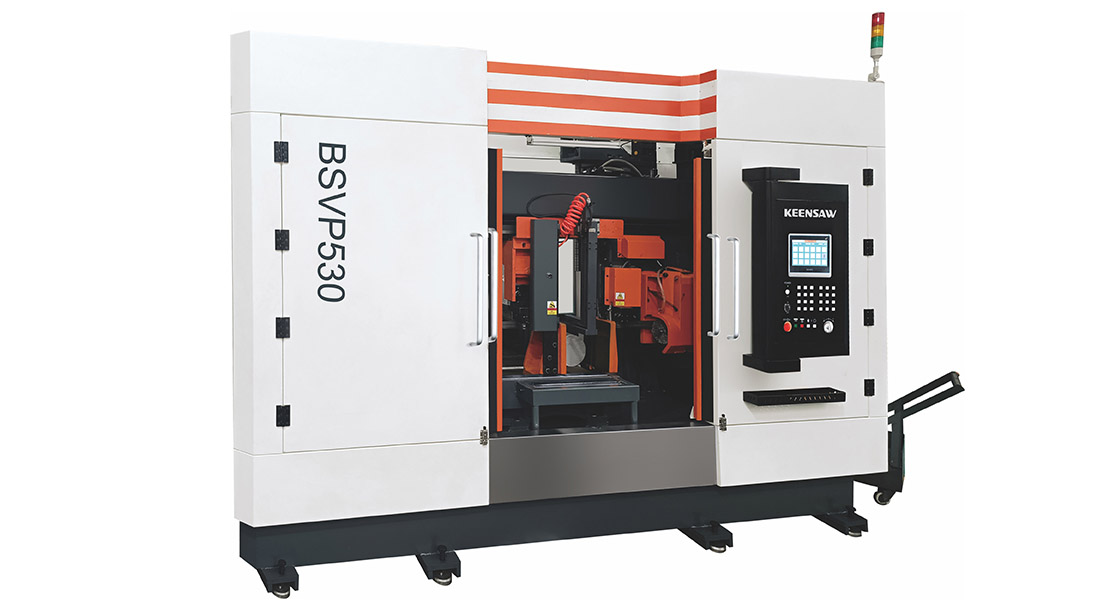
A CNC band saw is a horizontal or vertical band saw where the material feed, the clamping, the blade speed and the saw head descent are controlled by a program rather than by an operator holding a valve. The blade itself is the same continuous loop used on a manual machine. What changes is that the machine knows how far to feed, how hard to clamp and how fast to descend, and it repeats that without intervention.
That definition is deliberately narrow, because the market uses the term loosely. A machine with a digital length display and a pneumatic vice is not a CNC band saw, however it is advertised. The test is whether the machine can store and recall a set of parameters for a job, so that changing from one bar size to another is a program call rather than a sequence of manual adjustments.
A standard band saw is manual: you clamp the bar, set the length against a stop, lower the head by hand and release. A semi-automatic machine automates the cut and the head return but still needs the operator to feed each length. A CNC machine automates the feed as well, and that is the step that changes the labour content of the job.
| Control level | What is automatic | What you still do | Best fit |
|---|---|---|---|
| Manual | Nothing beyond the blade drive | Clamp, measure, lower, release, repeat | Job shop, one-offs, repair work |
| Semi-automatic | Cut stroke and head return | Feed each length by hand | Short runs, mixed sizes |
| CNC (programmed feed) | Feed, length, clamp, blade speed, descent | Load stock, check first piece, remove parts | Repeat work, long runs, bundles |
| CNC with loader | All of the above plus stock loading | Supervise, verify, change blades | High volume, lights-out shifts |
The jump from semi-automatic to CNC is the expensive one and the one worth arguing about, because it removes the operator from the cycle rather than just from the stroke. If your operator spends the day feeding lengths, the CNC pays back on labour. If your operator spends the day loading one 6-metre bar at a time anyway, the payback is thinner. The comparison is set out in more detail in automatic vs semi-automatic band saw: seven key differences.
The feed is the heart of a CNC band saw, and it is the part that determines whether the length you get is the length you asked for.
On the BSVP530CNC the material feed is hydraulic with a 500 mm index repeated as many times as the bar allows, and the saw feed is a 0.85 kW AC servo motor. Those two systems do different jobs: the material feed positions the bar, the saw feed controls how fast the blade enters it.
A servo saw feed is worth understanding because it is not the same as a hydraulic descent with a flow valve. A servo can hold a constant feed rate as the blade moves from a thin section into a thick one, and it can slow down on breakthrough where a hydraulic descent would accelerate. That is what protects the blade on the last few millimetres of a cut, which is where most teeth are lost.
Repeatability then comes from the combination of a rigid index and a clamp that does not let the bar creep. On a good machine you will hold a fixed length over a full bar. On a machine with a worn clamp you will hold it for the first fifty pieces and then watch it walk.
The commercial value of the control is in changeover, not in the cut. If you cut four bar sizes a week, a stored program means a size change is a clamp adjustment and a program call, measured in minutes. If you cut one size all month, the program is convenience rather than payback.
Where it earns its keep is mixed production. A service centre cutting to order can load a schedule, run each length in sequence, and let the machine index while the operator packs the previous batch. That is a labour model a semi-automatic machine cannot match, and it is the argument that usually closes the sale.
Cutting bundles rather than single bars?
The BSVP530CNC takes 530 mm round or 530 x 530 mm square, with hydraulic clamping, 20 to 120 m/min blade speed and a servo saw feed that holds back on breakthrough. Send your bundle size, bar count and material and we will confirm the blade and the clamp arrangement.
Bundle cutting is where a CNC band saw stops being a faster saw and becomes a different production method. You stack bars, clamp the stack as one workpiece, and cut the whole bundle in a single descent. Cycle time per piece drops by the number of bars in the stack, which is why the method is standard in rebar, fastener and bearing-race production.
The clamp is the whole job. A bundle needs a top clamp as well as side clamping, because the stack will settle as the blade enters and the upper bars will shift outward if nothing holds them down. Without a top clamp you get a cut that is square at the top of the stack, ragged in the middle and short at the bottom, and the operator blames the blade.
Squareness through the bottom row is the hardest part. The bottom bars carry the weight of everything above them, so the blade is cutting under load with the swarf having nowhere to go. Two things help: a coarse enough pitch that the teeth clear the chip, and a feed rate that stays constant rather than accelerating as the blade passes through the gaps between bars. A servo saw feed is what makes the second one possible.
There is also a stacking rule that costs money when it is ignored. Nest the bars so the bundle is as close to solid as the profile allows. A loose stack with air gaps lets the blade drop through the gaps and slam into the next bar, and that impact is what strips teeth rather than wear.
The G4240 is an example of a machine built for this specific job in rebar: a semi-automatic frame with the clamping arranged for bundle work rather than for a single bar, which is often the right answer where the volume is real but a full CNC is not justified.
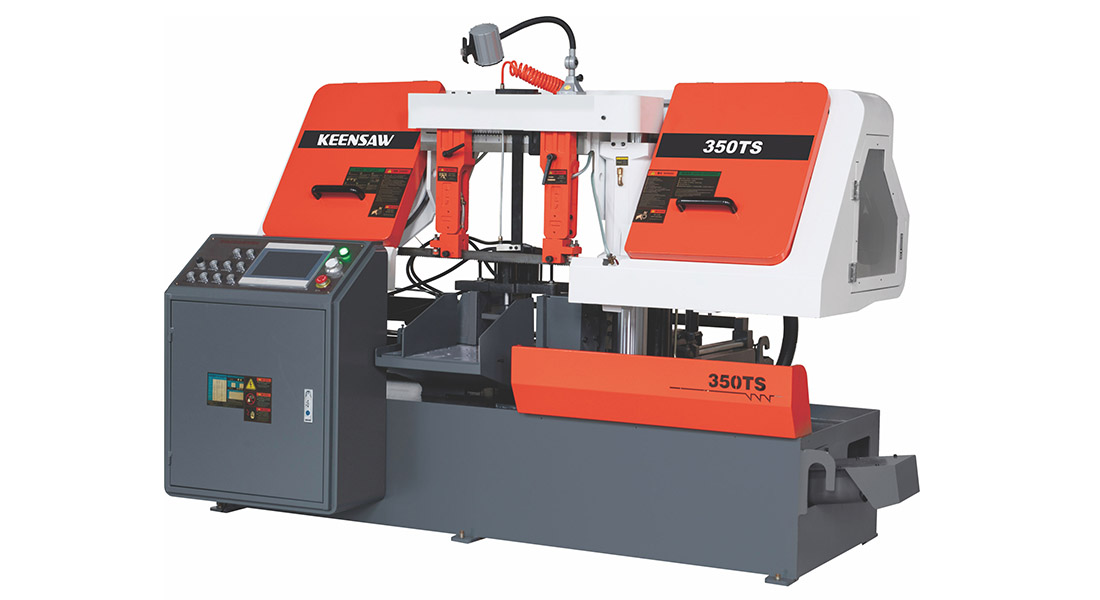
High speed in band sawing does not mean the blade runs at a high surface speed for its own sake. It means the machine can hold a high blade speed under load without losing the cut, and that is a function of frame rigidity, blade tension and the servo feed working together.
The BSVP series runs 20 to 120 m/min with a 15 kW blade motor on the 530 model. That range covers carbon steel at the bottom, through alloy and stainless in the middle, and aluminium and non-ferrous at the top. The value of the top of the range is not that you will cut steel at 120 m/min, because you will not; it is that the machine has headroom to hold speed while the blade is loaded, instead of sagging and rubbing.
High-speed machines earn their price in three situations: high-volume aluminium or non-ferrous cutting, production stainless where the blade must not dwell, and any job where the cut is the bottleneck in front of an automated line. If you are cutting carbon steel bar in modest volumes, a standard-speed automatic machine will do the same work with less machine to maintain.
The difference between a fast machine and a well-controlled one is covered in how to choose a metal cutting band saw machine, and if squareness is your current problem rather than speed, start with how to square a band saw cut.
Both machines cut metal. They differ in what the shop has to do around them, and that is where the decision should be made.
| Question | Semi-automatic | CNC |
|---|---|---|
| Who feeds the bar | The operator, every length | The machine, from a program |
| Labour per shift | One operator per machine | One operator can supervise several |
| Changeover between sizes | Manual adjustment each time | Program call plus clamp change |
| Bundle cutting | Possible with the right clamp | Built for it, with repeatable feed |
| Breakdown risk | Low, few systems | Higher, more systems to maintain |
| Payback | Immediate, low capital | Volume-dependent |
The honest reading of that table is that a semi-automatic band saw is not an inferior machine, it is a different answer. Where the volume is low, the sizes vary, and the operator has spare attention, a semi-automatic saw cuts the same metal for a fraction of the capital. Where the volume is steady and the length has to be identical at the end of the shift as at the start, the CNC machine is the only way to get there without adding an inspector.
We kept one semi-automatic saw after installing the CNC machines, and it still runs every day. It handles the odd jobs, the sample cuts and the oversize pieces that would take an hour to set up on a programmed machine. Buying two CNCs and scrapping the old saw would have been the wrong decision.
Field note from a steel service centre running three saws across two shifts
Not sure whether you need the CNC version?
Tell us how many bar sizes you cut in a week, how many pieces per shift and whether you bundle. If a semi-automatic machine covers it, we will say so; if the volume justifies the control, we will show you the numbers that decide it.
As many as fit in the clamping height without exceeding the machine capacity, but the practical limit is set by the blade. A small machine with a deep vice can physically hold a stack it cannot cut square, because the blade has to clear the bottom row with the full stack weight on it. Count rows, not pieces.
Usually because the stack has settled. The upper bars shift as the blade enters, the vice loses its grip on the middle of the stack, and the blade is suddenly cutting a moving load. Pre-clamping with a top clamp before the cut starts is the fix, not a slower feed rate.
Yes, and it is one of the reasons to choose a band saw over a circular saw, because the loop enters a profile a disc could never clear. The limit is throat depth and the clamping arrangement, since a profile wants support on the web as well as the flange.
A coarser pitch than the same material would need as a single bar, so the teeth clear the swarf from a wider cut. The rule is to keep two to three teeth in the wall or section at all times; in a bundle the effective section is the whole stack, so you can go coarser than instinct suggests.
It does not, unless you tell it. Most machines rely on the operator setting the start height or on a limit switch, so a bundle that is taller than the previous one will run with the blade approaching from too far away, which wastes cycle time but does not damage the cut.
No. Above the point where the teeth stop clearing the chip, more speed buys blade wear instead of throughput. The useful test is pieces per blade against pieces per hour, measured on your material; the fastest setting is rarely the cheapest one.
Bar straightness and clamp bite. A bent bar indexes along a curve, so the effective length changes as the bar advances, and a worn clamp lets the bar creep a little on every cycle. Neither shows up in the first ten pieces, which is why the tenth and the hundredth are worth measuring.
Normally yes with the right motor and inverter configuration, but confirm it before the order rather than after. Blade speed on a band saw is set by the inverter, so the machine is less frequency-sensitive than a fixed-speed saw, but the hydraulic and coolant motors still need to match your supply.
Blade tension, blade tracking and chip removal, in that order. A loose blade cuts out of square before it breaks, and a chip conveyor that has stopped quietly fills the base with swarf that then grinds the guide arms. Check tension with a gauge weekly, not by feel.
You cannot, in a single pass. The blade squares to the vice, not to the bar ends. Sort the bundle to a common end before loading, or accept that the first cut is a trimming pass and the second is the production cut.
Keep reading
Start with what a band saw machine is, part by part, then compare the different band saw machine types and automatic versus semi-automatic control.
Equipment
Compare the automatic band saw range, the high speed band saw range for production work, and the 530TS horizontal automatic band saw at 530 mm capacity.
A CNC band saw is worth its price when the length has to repeat without an operator and the volume justifies the capital. It is not worth it when the work is mixed, the runs are short and the operator has time to set a stop. Work out how many pieces a shift you actually cut, how many sizes you change in a week, and whether the bar arrives as single lengths or bundles. Those three answers decide the machine, and none of them appear in a specification sheet.
Contact us if you have any questions we will reply as soon aspossible