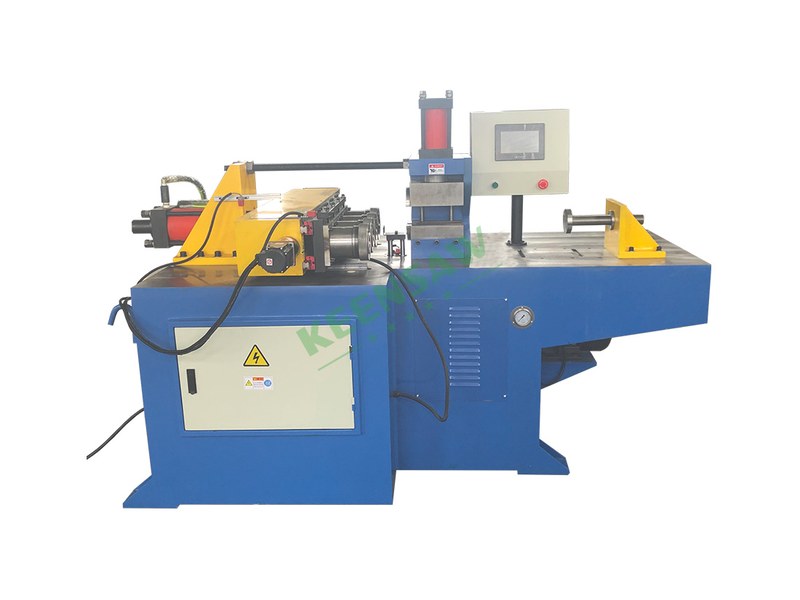
A single leaking refrigerant joint on an HVAC production line can trigger a full batch recall. A cracked brake-line flare in an automotive plant becomes a safety recall. In high-volume tube processing, the end of the tube is where quality is won or lost—and where most shops quietly bleed money on rework, scrap, and manual handling. The fix is not “better operators.” It is process consolidation: moving flaring, expanding, and beading onto one multi-station pipe end forming machine that completes every operation in a single clamped cycle.
KEENSAW has shipped end formers to more than 40 countries and runs an ISO 9001:2016 + CE certified plant. This guide consolidates the engineering decisions B2B buyers actually need—forming operations, machine architecture, servo vs. hydraulic, and how a multi-station cell eliminates the secondary-handling losses that destroy throughput.
Tube end forming is a cold-forming process that reshapes the end of a metal tube or pipe without removing material. Unlike machining or welding, the geometry is changed through controlled axial pressure and precision tooling—below the metal’s recrystallization temperature. The result is zero material waste, tight repeatability, and functional connection features (flares, beads, expansions) engineered directly into the tube end.
| Forming Operation | What It Does | Typical Application |
|---|---|---|
| Expanding | Enlarges tube-end OD to slip over another component | Heat exchanger tubesheets, HVAC copper joints |
| Reducing | Decreases tube-end OD to insert into smaller ID | Automotive fuel & brake lines |
| Flaring | Produces a sealing cone / 90° flange for leak-tight joints | Refrigeration, hydraulic, plumbing |
| Beading (Bulge) | Creates a circumferential ridge for hose retention / O-ring seat | Hose assemblies, exhaust, fluid transfer |
| Flanging | Forms a flat rim for bolting / gasket sealing | Industrial piping, structural frames |
| Rounding | Smooths a cut end for clean insertion | Furniture, tubing inserts |
Before choosing stations, you choose the forming method. Each trades force, surface finish, and wall control differently:
| Architecture | How It Works | Best For |
|---|---|---|
| Ram (Linear) | Hydraulic punch forces the tube against a fixed die | High-force reducing, thickening, large OD |
| Segmented (I/O) | Fingers open/close around the tube end to expand or bead | Flaring, beading, expanding on thin/medium wall |
| Rotary / Spin | Spinning head hammers the tube as it feeds in | Cosmetic beading, closing, thin-wall gentle forming |
Running expanding, beading, and flaring on three separate machines creates four invisible costs: extra labor handling, cumulative positioning error between stations, longer cycle time, and inconsistent dimensions across operations. A multi-station tube end forming machine completes all operations in one clamped setup—better concentricity, lower reject rate, higher daily output.
| Factor | Single-Station | Multi-Station (3–5) |
|---|---|---|
| Operations per cycle | 1 | Up to 5 (expand+bead+flare+chamfer) |
| Handling steps | Manual between machines | Zero (auto index) |
| Concentricity | Limited by re-clamping | Held in one chuck |
| Output / shift | Lower | Higher |
For thin-wall copper HVAC tubing, wall thinning during expansion is the #1 scrap driver. Servo-controlled forming holds a stable deformation speed; hydraulic-only systems struggle with thin-wall consistency. The hybrid answer many factories land on: hydraulic clamping + servo forming stroke.
| Parameter | Hydraulic | Servo-Electric |
|---|---|---|
| Force output | Higher (large OD / thick wall) | Medium–high |
| Position accuracy | Moderate | Very high (±0.01mm) |
| Energy use | Higher | Lower |
| Noise | Higher | Lower |
| Thin-wall control | Average | Excellent |
| Automation / MES | Moderate | Excellent |
KEENSAW’s KTF-40-M multiple-station tube end forming machine is built for HVAC copper and automotive thin-wall lines up to Ø40 mm.
| Specification | KTF-40-M |
|---|---|
| Max diameter | 40 mm |
| Max wall thickness | 1.5 mm |
| Max processing length | 100 mm |
| Main cylinder output | 4.0 kW |
| Hydraulic pressure | 12 MPa |
| Dimensions (L×W×H) | 2000 × 1400 × 1450 mm |
| Weight | 1000 kg |
Each material forms differently—tooling and lubrication must follow:
Ready to size a multi-station end former for your line?
KEENSAW engineers will run a forming-process analysis on your actual tube samples.
It performs several end-forming operations—expanding, reducing, flaring, beading, flanging—on one tube end within a single clamped cycle, eliminating manual handling between separate machines. It is used for HVAC copper joints, automotive brake/fuel lines, and heat-exchanger manifolds.
Tube forming reshapes the entire tube; tube end forming reshapes only the end section. End forming is the standard method for creating flares, beads, and expansions used in connections.
Servo gives higher position accuracy (±0.01mm), lower energy/noise, and excellent thin-wall control—ideal for copper HVAC and stainless. Hydraulic delivers higher force for large OD / thick wall. A hybrid (hydraulic clamp + servo stroke) is often best.
Copper, brass, aluminum, stainless steel, carbon steel, and many alloys. Material behavior dictates tooling and lubrication—stainless needs anti-galling lube; aluminum needs speed control to avoid work hardening.
Three operations typically need a 3–5 station machine so each operation gets a dedicated tool position with margin for future parts. The KEENSAW KTF-40-M class supports multi-station layouts.
Excess deformation speed over-thins the wall and causes leaks. Servo-controlled stroke speed and correct segment finger geometry keep wall thickness in tolerance and cut scrap rate.
HVAC & refrigeration, automotive (brake/fuel/exhaust/EV cooling), heat exchangers, aerospace, and medical tubing—anywhere leak-tight, repeatable joints matter.
Yes. KEENSAW supplies pipe bending machines and chamfering machines so end forming becomes one cell in a complete tube-processing line.
Look for CNC flexibility, tooling customization, sample testing, export experience, and after-sales support. KEENSAW is ISO 9001:2016 + CE certified and exports to 40+ countries.
Cycle time depends on stations and stroke, but consolidating 3–4 operations into one setup typically cuts total handling time by 60–70% versus separate machines, with the forming stroke itself often under 10 seconds per end.
Build a leak-free tube line with KEENSAW
Talk to our engineers about a forming + cutting + chamfering cell tailored to your parts.
Contact us if you have any questions we will reply as soon aspossible