For many in the metal fabrication industries, a bandsaw is the backbone of the workshop. But for newcomers or procurement managers, the first question is often:
“Whats a band saw, and what does a bandsaw do exactly?”
Simply put, a bandsaw is a power saw with a long, sharp blade consisting of a continuous band of toothed metal stretched between two or more wheels. The primary uses of a bandsaw include cutting irregular shapes and resawing lumber into thinner slabs, but its most critical industrial role is cutting metal with a band saw. To get the most out of your machine, you must understand the different bandsaw blade types available in the market.
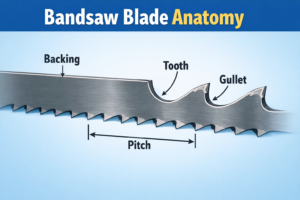
Choosing the wrong blade can lead to wasted material and broken equipment. Here is a breakdown of the most common band saw blade types used in modern manufacturing:
| Blade Type | Best For | Key Feature |
| Bi-Metal | Bandsaw blades for cutting steel | High-speed steel teeth bonded to a flexible back for extreme durability. |
| Carbide-Tipped | Aerospace alloys & Hard metals | Extremely hard teeth designed for fast cutting of high-strength alloys. |
| Carbon Steel | Softer metals | Cost-effective for light-duty tasks, but lacks heavy-duty longevity. |
| Knife Blade | Foam, Rubber, Soft materials | A razor-sharp, toothless edge for slicing without creating dust. |
The best band saw blades for metal. These are engineered to handle the intense heat generated when cutting metal with a band saw, providing a much tougher cutting edge than standard blades.
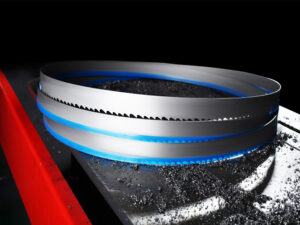
Engineered for the most demanding industrial tasks, these are the best band saw blades for metal that standard Bi-metal blades cannot handle, such as titanium, nickel-based alloys, and case-hardened steel. The teeth are tipped with high-grade tungsten carbide, providing extreme wear resistance and the ability to maintain a sharp edge under intense heat and high-speed production.
Best for general-purpose cutting of softer metals. While less expensive, they lack the longevity required for heavy industrial bandsaw blades.
Not all blades have teeth. A band saw knife blade features a razor-sharp edge used for slicing through soft materials like foam, rubber, or bread without creating dust or jagged edges.
One of the most common mistakes is ignoring bandsaw blade sizes. If the blade is even a fraction of an inch too long or too short, it won’t tension correctly.
Length: Measured as the total circumference of the loop.
Width: Wider blades are used for straight, heavy-duty cuts, while narrower types of band saw blades are ideal for tight curves.
Thickness: Also known as the “gauge,” this must match your wheel diameter to prevent metal fatigue.
In high-output environments, efficiency is everything. When you are cutting metal with a band saw, you need to consider the TPI (Teeth Per Inch).
For Thick Solids: Use a lower TPI to allow for better chip clearance.
For Thin Tubing: Use a higher TPI to ensure at least three teeth are in contact with the metal at all times. Keensaw specializes in high-performance bandsaw blades for cutting metal, ensuring that every cut is clean and every blade lasts through rigorous shifts.
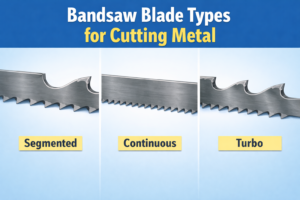
Knowing how to use a bandsaw correctly is vital for both safety and blade longevity. Follow these three rules:
A loose blade will wander and cause inaccurate cuts.
An over‑tight blade may snap suddenly, risking injury and damage.
Start with a reduced feed rate for the first few cuts.
This gently hones the teeth and extends blade life.
Avoid fast feeding during break‑in to prevent chipped teeth.
Coolant reduces friction, lowers heat, and prevents blade overheating.
It also flushes away metal chips to ensure clean, smooth cuts.
Proper cooling improves cut quality and prolongs blade service life.
Q: What is the primary use of a bandsaw in industry?
A: It is primarily used for the precision cutoff of metal bars, tubes, and thick industrial plates.
Q: How do I know which bandsaw blade types I need?
A: Selection depends on your material hardness, thickness, and your machine’s speed capabilities.
Q: Is “bandsaw how to use” training available?
A: Keensaw provides technical manuals and online support to help your team optimize blade performance.
Q: Can I use bandsaw blades for cutting metal?
A: Yes, but it is less efficient; it is always better to match the blade to the specific material.
Q: Why choose Keensaw over cheaper brands?
A: Our blades offer a lower total cost-of-ownership by providing superior wear resistance and far fewer blade changes.
Q: What are the best band saw blades for metal?
A: Bi-metal M42 blades are the industry standard for their excellent balance of high-speed toughness and long-term durability.
Understanding the various types of bandsaw blades and the specific uses of a bandsaw is the key to a profitable workshop. Whether you are looking for the best band saw blades for metal or need custom bandsaw blade sizes for a specialized machine, Keensaw provides the engineering expertise you need.
Contact us if you have any questions we will reply as soon aspossible