Both machines index the bar automatically, clamp it hydraulically and cut without an operator standing over them. The difference is what happens inside the cut. A high-speed band saw machine controls the down-feed with a servo and reacts to load in real time; a conventional automatic band saw pushes the head down with a hydraulic cylinder set before the cut starts. That one architectural choice changes cycle time, blade cost and the range of material you can run. Here is how to tell which one your production actually needs.
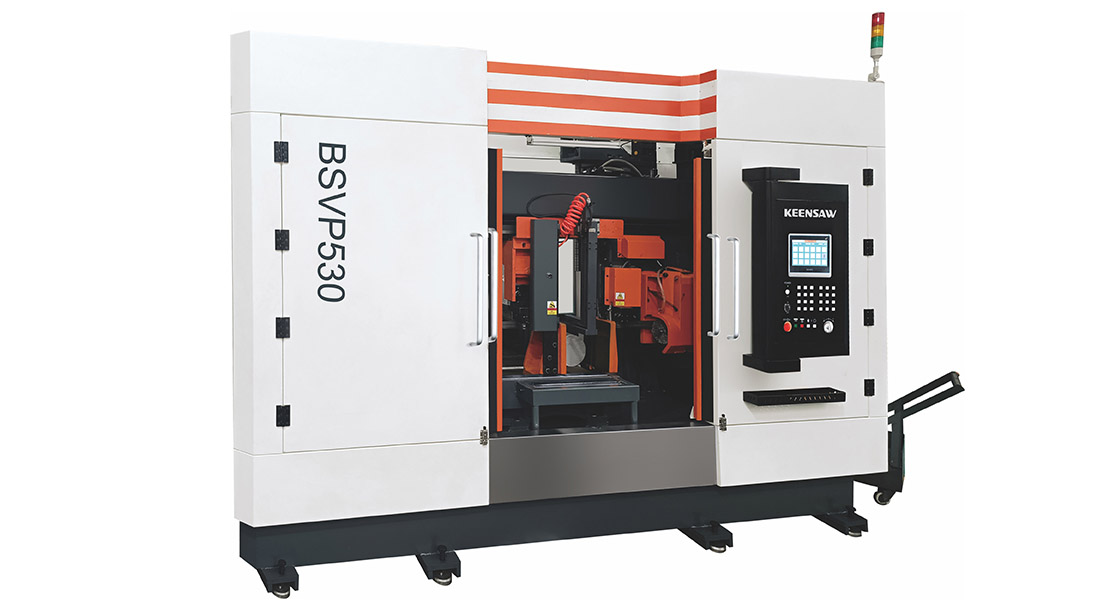
Read a spec sheet and the two machines look almost identical: same capacity, same blade size, same hydraulic clamping. The differences sit in four systems that spec sheets usually undersell.
| System | Conventional automatic band saw | High-speed band saw machine |
|---|---|---|
| Saw feed | Hydraulic cylinder, feed rate set before the cut | AC servo down-feed, rate adjusted during the cut |
| Tension de la lame | Manual or spring, set at blade change | Hydraulic, held constant through the cut |
| frame | Cast or welded, adequate for moderate feed | Heavier section, dual-column or box frame to resist twist at high feed |
| Contrôle | Length, count, clamping sequence | Length, count, plus feed, load and blade speed recipes per material |
| Best fit | Mixed job work, occasional heavy sections, tight budget | Repeat production, alloy and stainless, high pieces per shift |
A hydraulic down-feed has one job: push at the pressure you set. When the blade hits a hard inclusion or the section widens, the load spikes, the blade deflects, and the tooth takes a hit it was not designed for. The servo version reads load and slows down before that happens. On the BSV7050CNC the head is driven by a 1.3 kW AC servo, which is what allows a 41 mm blade to run at 20-60 m/min through a 700 by 500 mm section without stalling.
The result is not just speed. It is a flatter load curve, which means fewer stripped teeth, longer blade life, and a cut face that stays consistent from the first piece of the bar to the last. On stainless and alloy steel that difference in blade life is usually the whole business case.
As a blade heats up it stretches. On a manually tensioned machine the blade goes slack mid-cut, wanders in the kerf, and cuts a slightly bell-mouthed section. Hydraulic tension holds the preload constant, so the blade tracks straight for the whole shift. If you cut large sections or run long cycles, this alone justifies the step up.
Do not compare these machines on cycle time alone. Compare cost per cut, because the fast machine usually wins on blade consumption before it wins on seconds.
| Cost line | What drives it | How to measure it |
|---|---|---|
| Blade cost per cut | Teeth stripped, blade breakage, premature wear | Blade price divided by pieces cut per blade |
| Labor per cut | How often someone has to intervene | Operator minutes per 100 pieces |
| Scrap per cut | Squareness drift, kerf loss, tailing length | Rejected pieces per shift, plus millimetres lost to kerf |
A useful rule of thumb: if your blade spend per month is a meaningful fraction of your operator cost, the high-speed machine will pay back faster than the spreadsheet suggests. If you cut ten pieces a day of mixed sizes, it will not, and a conventional automatic saw is the honest answer.
Cutting 500 mm bar or 700 by 500 mm blocks all day?
The BSV7050CNC runs an 11 kW blade motor, a 7,540 mm blade at 20-60 m/min, servo down-feed and hydraulic tension, with 500 mm multi-stroke indexing. Send your section sizes and daily piece count for a cycle-time estimate.
You run the same family of sections repeatedly, your material is alloy or stainless where blade life matters, and the saw is a bottleneck rather than a utility. The recipe system also matters when several operators share the machine, because the cut parameters stop depending on who set it up.
Your mix changes daily, sections are moderate, and the saw runs a few hours a day rather than a full shift. A conventional automatic band saw is simpler to repair, cheaper to own and perfectly capable in mild steel at moderate feed. Buying a high-speed machine for job work is buying capability you will not use.
If you are still choosing between automation levels rather than machine classes, read automatic vs semi-automatic band saw first. The decision order is: automation level, then machine class, then blade.
Does a high-speed band saw need a different blade?
It can run standard bi-metal blades, but it rewards a blade built for the higher feed: consistent set, tight back-edge thickness tolerance and a tooth geometry matched to the material. A cheap blade on a fast machine simply fails faster than it would on a slow one.
Will a high-speed machine cut titanium or Inconel?
It can, at low blade speed and with a feed that keeps the tooth cutting rather than rubbing. The advantage is not speed on those alloys, it is the load feedback that prevents the tooth from stalling and work-hardening the surface. Expect to run well below the machine’s maximum.
How much floor space does a 500 mm class machine need?
The BSV7050CNC measures 3,900 by 2,600 mm and weighs 6,500 kg, and you still need clearance for bar loading and part removal. Plan for roughly 1.5 m of working space on the load side and a chip bin position on the discharge side.
Is a foundation required?
A machine of this mass usually sits on levelling pads on a sound concrete slab rather than a poured foundation, but the slab has to be flat and thick enough not to flex. Check the installation drawing before you pour anything; retrofitting a base is expensive.
Why does the blade track wander after a few hours?
Three usual suspects: tension lost as the blade warms, worn guide inserts, or coolant that has stopped reaching the guides. Check guide clearance first, then confirm tension, then coolant flow at the nozzle rather than at the pump.
Can I retrofit servo feed to an existing automatic saw?
Occasionally, if the frame is rigid enough and the control supports it, but the cost rarely justifies it. The frame, guides and tension system are designed as a set; adding a servo to a machine built for hydraulic feed usually moves the failure point rather than removing it.
What blade speed should I start with on mild steel?
Start in the lower half of the machine’s range and raise speed only while the chip stays a proper curl and the cut face stays clean. If the chip turns blue or the section starts to shine, you have gone too far and are polishing rather than cutting.
How often should hydraulic oil and filters be changed?
Follow the maker’s interval, and shorten it if the machine runs in a dusty shop or the oil temperature climbs. On a high-speed machine the hydraulics also hold the tension, so degraded oil shows up as inconsistent blade tracking before it shows up as a pressure fault.
Does a bundle clamp work on a high-speed machine?
Yes, and it is one of the few places where high feed really shines, because a tight bundle presents a near-solid section. It does demand square-cut bar ends and consistent bundle height, otherwise the blade loads up and down through the stack.
Is the faster machine always the more productive one?
No. Productivity is pieces per hour including blade changes, setup and waiting. A machine that cuts in 40 seconds but loses 20 minutes a shift to blade swaps can be beaten by a slower machine that runs unattended for eight hours.
Keep reading
Pair this with automatic vs semi-automatic band saw, and set the blade correctly with the band saw blade TPI chart.
Equipment
Compare models in the high speed band saw range et le automatic band saw range.
Buy the high-speed band saw machine when the saw is a production bottleneck and blade cost is visible on your P and L; stay with the conventional automatic band saw when the saw is a supporting tool and your mix changes every day. Neither machine is better in the abstract, and the spec sheet will not tell you which you are. Your pieces per shift, your material grade and your blade spend will, which is exactly the information we ask for before recommending a model.
Contactez-nous si vous avez des questions, nous vous répondrons dans les plus brefs délais