In metal fabrication and steel processing, the band saw is often the bottleneck that determines whether a production line hits its daily tonnage target or falls short. When procurement teams and production managers evaluate new sawing equipment, one architectural decision outweighs nearly every other specification on the data sheet: scissors-style (pivot) versus dual-column (gantry) construction.
Both designs use a continuous looped blade to cut metal, but the way each machine guides that blade through the workpiece is fundamentally different—and those differences ripple through cutting accuracy, blade life, throughput, and total cost of ownership. This guide breaks down the two architectures factor by factor so B2B buyers can confidently select the right band saw for their high-volume production environment.
Whether you are cutting solid round bars, structural profiles, or large forging billets, understanding these structural distinctions is the first step toward maximizing your sawing department’s ROI. For a broader overview of available configurations, see our guide on Understanding Different Bandsaw Machine Types.
A scissors-style band saw—also called a pivot-type or scissor-type saw—uses a single pivot bearing on one side of the machine. The saw head rotates downward around this pivot point in an arc, feeding the blade into the material at an angle. The name comes from the motion: the head swings down like a pair of scissors closing.
This architecture is mechanically simpler than a dual-column design. Fewer moving parts mean lower manufacturing cost, a smaller footprint, and easier maintenance. The pivot mechanism is well suited to cutting structural shapes—such as I-beams, angle iron, and square tubing—because the angled blade entry reduces drift on these asymmetric profiles.
However, the same pivot motion that makes the design economical also introduces uneven downfeed pressure. The force is greatest near the pivot bearing and weakest at the far end of the blade. On larger-diameter solids, this uneven distribution can cause the blade to wander, producing tapered cuts and accelerating tooth wear.
KEENSAW’s scissors-style lineup includes the GW4028A scissor-style horizontal semi-automatic miter band saw, designed for shops that need reliable miter cutting without the footprint of a full gantry machine.
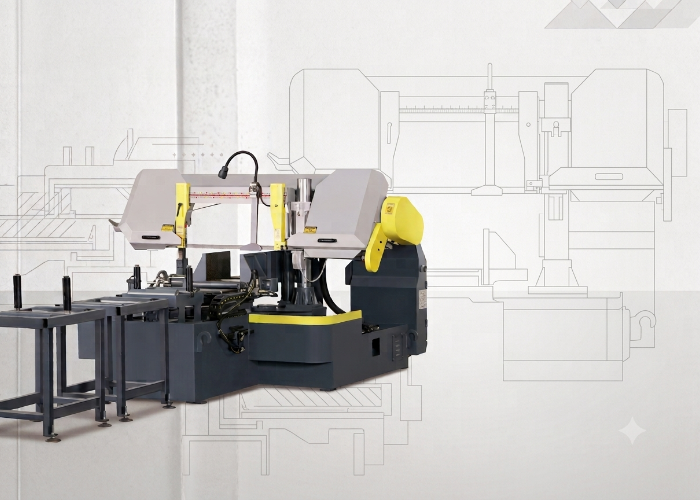
A dual-column band saw—sometimes called a double-column or gantry saw—supports the saw head on two precision-ground vertical columns with linear guide bearings. Instead of pivoting, the entire saw frame descends straight down in a parallel motion, keeping the blade perpendicular to the workpiece throughout the cut.
This twin-column architecture delivers significantly higher structural rigidity. The balanced support on both sides of the blade eliminates the uneven pressure distribution inherent in pivot designs, allowing the blade to take the shortest possible path through the material—straight across the diameter rather than along an arc. The result is faster cycle times, straighter cuts, and longer blade life.
Dual-column saws excel in demanding applications: large-diameter solid rounds (typically above 300 mm), heavy wall tubes, forging billets, and bundle cutting of multiple bars secured in a single clamp. The added rigidity also dampens vibration during high-speed cutting of superalloys and tool steels, protecting both cut quality and blade integrity.
For an in-depth look at this architecture in heavy-duty applications, read our analysis of heavy-duty dual-column band saws engineered for large billets and forging steel processing.
Rigidity is the foundation of cut quality. A dual-column saw frame moves on two parallel linear guides, distributing cutting force symmetrically across the blade. This balanced geometry minimizes frame deflection and absorbs the kinetic energy generated during high-speed cuts, effectively damping vibration before it reaches the tooth tips.
A scissors-style saw, by contrast, applies force through a single pivot axis. The cantilevered head is inherently less rigid, and the angular descent path means the blade encounters changing resistance as it sweeps through the material. For light to moderate cutting this is acceptable, but on large solids or hard alloys the added vibration accelerates tooth chipping and reduces cut straightness.
Verdict: Dual-column wins on rigidity and vibration damping—critical for high-volume production of large or hard materials.
The path the blade takes through the workpiece directly affects cut tolerance. On a dual-column saw, the blade descends vertically and cuts straight across the material diameter—the shortest possible path. This produces consistent, parallel cuts with minimal taper, even on large cross-sections.
On a scissors-style saw, the blade follows an arc. As the head pivots downward, the entry angle changes continuously, and the cutting force vector shifts. For structural profiles this can actually be advantageous—the steeper entry angle reduces drift on asymmetric shapes. But for round solids and heavy bars, the arc path tends to produce a slight taper and can cause the blade to deviate on deeper cuts.
Verdict: Dual-column wins for precision on solids and large bars; scissors-style can be preferable for structural profiles.
Blade consumables are a significant recurring cost in any sawing operation, often exceeding the machine’s purchase price over its service life. The relationship between architecture and blade life is straightforward: less vibration and more even pressure mean longer blade life.
Dual-column saws extend blade life through uniform downfeed pressure and superior vibration damping. The blade stays perpendicular to the workpiece, preventing the beam deflection that causes premature tooth wear on one side. Many dual-column machines also offer hydraulic blade tensioning systems that maintain optimal tension throughout the cut, further protecting the blade.
Scissors-style saws, with their uneven pressure distribution and higher vibration levels, typically consume blades faster—especially when cutting harder materials or larger cross-sections. For an economic analysis of this cost factor, see our article on band saw blade performance and cost comparison.
Verdict: Dual-column delivers measurably longer blade life, reducing consumable costs over time.
Throughput is where the dual-column architecture pays for itself. Because the blade takes the shortest path through the material (straight across the diameter rather than along an arc), each cut cycle is shorter. Combined with the ability to run higher blade speeds and downfeed rates without vibration-induced quality loss, dual-column saws consistently outproduce pivot-type machines on solid materials.
For operations running multiple shifts or processing high volumes of bars and billets, this throughput advantage compounds rapidly. A 15–20% reduction in cycle time per cut can translate to hundreds of additional parts per shift.
Scissors-style saws remain competitive on lighter, intermittent cutting tasks where cycle time is less critical. For shops evaluating their overall sawing strategy, our Industrial Bandsaw Machine Selection Guide provides a structured framework.
Verdict: Dual-column wins on throughput for high-volume solid cutting; scissors-style is adequate for lower-volume or mixed work.
Cutting capacity is where the architectural divide is most visible. Scissors-style saws are generally designed for smaller to mid-range materials—typically up to 250–300 mm in round capacity. Beyond that range, the pivot mechanism’s lack of rigidity becomes a limiting factor for both quality and safety.
Dual-column saws are built for large cross-sections. Their rigid frame handles solid rounds from 300 mm up to 1,500 mm and beyond, making them the standard choice for forging shops, steel service centers, and heavy fabrication. The twin-column design also supports bundle cutting—processing multiple bars secured in a single clamp—with hydraulic top clamps that prevent individual bars from spinning or shifting during the cut.
If you need help determining the right capacity for your materials, our guide on what industrial bandsaw size you need walks through the calculation.
Verdict: Dual-column is the clear choice for large solids and bundle cutting; scissors-style handles smaller profiles effectively.
Scissors-style saws have a compact advantage. The pivot design requires less floor space, a simpler foundation, and lower power infrastructure. For smaller shops or facilities adding a backup saw in a tight layout, this can be a deciding factor.
Dual-column saws are larger and heavier, requiring a more substantial foundation—often a dedicated concrete pad—to support the machine’s weight and absorb cutting forces. Power and coolant requirements are also higher. However, the productivity gains typically justify the infrastructure investment for high-volume operations.
For a detailed breakdown of footprint, motor power, and material handling considerations, see our industrial horizontal band saw sourcing guide.
Verdict: Scissors-style wins on compactness and installation simplicity; dual-column requires more infrastructure but delivers higher productivity.
Scissors-style band saws carry a lower purchase price—often 30–50% less than a comparably sized dual-column machine. For low-volume shops, job shops with intermittent cutting needs, or facilities that primarily process structural shapes, this cost advantage makes the pivot design the economically rational choice.
Dual-column saws demand a higher upfront investment, but the ROI math favors them when production volume is high. The combination of faster cycle times, longer blade life, and higher cut quality reduces the per-part cost significantly. For a two- or three-shift operation processing solid bars or forging billets, the price premium is typically recovered within 12–24 months through reduced consumable costs and increased throughput.
Verdict: Scissors-style wins on initial cost; dual-column wins on long-term ROI for high-volume production.
| Factor | Scissors-Style (Pivot) | Dual-Column (Gantry) |
|---|---|---|
| Blade descent path | Arc (pivots on one side) | Vertical (guided on two columns) |
| Structural rigidity | Moderate (cantilevered head) | High (symmetrical twin-column support) |
| Vibration level | Higher | Lower (superior damping) |
| Downfeed pressure | Uneven (strongest near pivot) | Even across full cutting width |
| Cut accuracy on solids | Moderate (possible taper on deep cuts) | High (parallel, taper-free cuts) |
| Best for structural shapes | Yes (less blade drift on I-beams) | Adequate but not optimized |
| Blade life | Shorter | Longer (uniform wear) |
| Cycle time per cut | Longer (arc path) | Shorter (shortest path) |
| Max round capacity | Typically up to ~300 mm | 300 mm to 1,500 mm+ |
| Bundle cutting | Limited | Excellent (hydraulic top clamps) |
| Floor space | Compact | Larger (requires solid foundation) |
| Initial cost | Lower (30–50% less) | Higher |
| ROI timeline | Immediate savings on purchase | 12–24 months at high volume |
| Ideal use case | Job shops, backup saws, structural profiles, low-to-mid volume | Steel service centers, forging shops, high-volume solid cutting, bundle processing |
Use the following criteria to match your operational profile with the right band saw architecture.
Explore KEENSAW’s semi-automatic band saws and the GZ4028 automatic metal cutting bandsaw machine for compact, cost-effective solutions.
Review KEENSAW’s full range of band saw machines and automatic band saws to find the right dual-column configuration for your production line.
Use this checklist during your equipment evaluation to ensure you cover every critical decision factor before committing to an architecture.
| # | Evaluation Question | Points to Scissors-Style | Points to Dual-Column |
|---|---|---|---|
| 1 | What is your maximum solid round bar diameter? | Under 250–300 mm | Over 300 mm |
| 2 | How many shifts does your sawing department run? | Single shift, intermittent | Two or three shifts, continuous |
| 3 | Do you need bundle cutting capability? | Rarely or never | Frequently, multiple bars per cut |
| 4 | What material types do you primarily cut? | Structural shapes, tubes, profiles | Solid bars, billets, hard alloys |
| 5 | What is your required cut tolerance? | Standard commercial tolerance | Tight tolerance, minimal taper |
| 6 | Is floor space a constraint? | Yes, compact footprint needed | No, dedicated foundation available |
| 7 | What is your annual blade consumable budget? | Accept higher per-blade cost | Need to minimize blade costs long-term |
| 8 | Do you cut hard or abrasive materials? | Mild steel, aluminum, copper | Tool steel, stainless, superalloys |
If four or more answers point toward dual-column, the long-term economics favor that architecture for your operation. For additional guidance on whether a band saw is the right machine category for your needs, see Why Do I Need a Bandsaw Machine?
The fundamental difference is the blade descent mechanism. A scissors-style (pivot) band saw swings the saw head downward around a single pivot bearing on one side, causing the blade to enter the material along an arc. A dual-column (gantry) band saw lowers the saw frame vertically on two parallel guide columns, keeping the blade perpendicular to the workpiece throughout the cut. This structural distinction affects rigidity, cut accuracy, blade life, throughput, and maximum cutting capacity.
Dual-column band saws are strongly recommended for solid rounds exceeding 300 mm in diameter. The twin-column design provides the rigidity needed to maintain blade perpendicularity on large cross-sections, prevents taper, and absorbs the higher cutting forces generated by deep cuts. Scissors-style saws typically lack the structural stability to produce consistent results at these diameters.
Scissors-style saws can perform limited bundle cutting on smaller-diameter materials, but they are not ideal for this application. The uneven downfeed pressure inherent in the pivot design can cause individual bars in a bundle to shift, leading to blade pinching and premature tooth failure. Dual-column saws with hydraulic top clamps are the preferred architecture for reliable, high-volume bundle cutting.
Dual-column band saws typically cost 30–50% more than scissors-style saws of comparable cutting capacity, due to the more robust frame, precision linear guides, and heavier base construction. However, for high-volume operations, the premium is usually recovered within 12–24 months through faster cycle times, longer blade life, and reduced per-part cost. For low-volume or intermittent cutting, the lower initial cost of a scissors-style saw is often the better economic choice.
Dual-column band saws produce straighter cuts on large-diameter solids. The vertical blade descent on twin linear guides ensures the blade travels straight across the material diameter, maintaining a consistent cutting plane. Scissors-style saws, with their arc-path descent and uneven pressure distribution, tend to introduce taper on deeper cuts—especially on materials above 200 mm in diameter.
For a two- or three-shift operation processing solid bars or forging billets at high volume, the typical ROI timeline is 12–24 months. The payback comes from three sources: reduced blade consumable costs (longer blade life due to lower vibration and even pressure), increased throughput (15–20% shorter cycle times from the shortest-path cut), and reduced rework (fewer tapered or out-of-tolerance cuts requiring secondary machining). Operations running a single shift with intermittent cutting will see a longer payback period.
Yes. Dual-column saws are larger and heavier than scissors-style machines of equivalent cutting capacity. They require a more substantial foundation—often a dedicated reinforced concrete pad—to support the machine weight and absorb cutting forces. Coolant and power requirements are also higher. Scissors-style saws have a smaller footprint and simpler installation, making them suitable for facilities with limited floor space.
Scissors-style band saws can be the better choice for structural shapes such as I-beams, angle iron, and square tubing. The angled blade entry of the pivot mechanism reduces blade drift on these asymmetric profiles, producing cleaner cuts. Dual-column saws are optimized for solid rounds and heavy billets where perpendicular descent is critical, but they can still cut structural shapes effectively when needed.
Dual-column band saws consistently deliver longer blade life. The even downfeed pressure across the full cutting width, combined with superior vibration damping, prevents uneven tooth wear and the beam deflection effect that shortens blade life on pivot-type machines. The exact improvement varies by material and application, but dual-column saws commonly achieve 20–40% longer blade life on comparable cutting tasks—a significant cost reduction given that blade consumables often exceed the machine’s purchase price over its service life.
In most cases, yes—bi-metal and carbide-tipped blades are compatible with both architectures, provided the blade length, width, and thickness match the machine’s specifications. However, the blade will typically last longer on a dual-column saw due to the lower vibration and more uniform cutting forces. When selecting blades, also consider the material being cut: harder alloys benefit from variable-pitch bi-metal or carbide blades regardless of the saw architecture. KEENSAW supplies band saw machines compatible with standard bi-metal and carbide blade specifications.
Existing guides on KEENSAW:
Recommended future articles:
Need help selecting the right band saw architecture for your production line? Contact KEENSAW today for a personalized consultation with our engineering team.
Contact us if you have any questions we will reply as soon aspossible