In high-volume metal fabrication, automotive component manufacturing, and structural steel service centers, throughput is determined by the efficiency of your entire floor, not just a single workstation. When structural engineering or procurement teams evaluate their cutting options, they often search for the right equipment using a single parameter: maximum cutting diameter. However, true operational cost-efficiency depends on a much larger picture—how raw material cuts feed into your downstream production machinery.
If you are evaluating the various bandsaw machine types available on the market, it is essential to look at the process as a cohesive pipeline. Cutting raw metal bar stock, heavy beams, or bundled steel tubing is merely the opening step. The precision, speed, and edge quality delivered during this initial phase dictate the performance of your downstream equipment, such as an automatic chamfering machine, a CNC pipe bending machine, or a pipe end forming machine. This comprehensive blueprint outlines the core industrial saw configurations and explains how to align your choice of cutting machinery with your overall manufacturing line to maximize your factory’s return on investment (ROI).
Understanding the engineering strengths of different horizontal and vertical bandsaw configurations allows you to select a machine base that prevents production bottlenecks, extends blade life, and ensures tight geometric tolerances.
When a blade encounters a thick, solid metal mass, it is subjected to massive, unequal counter-forces that try to push it off-course. Light-duty pivot or scissor-style saws struggle under this intense resistance, resulting in a common defect known as “blade wandering,” which yields crooked, uneven cuts.
For dense solids, a heavy-duty industrial horizontal saw built on a rigid dual-column (twin-pillar) framework is an absolute necessity. Traveling vertically along twin chromed steel pillars via parallel hydraulic cylinders, the entire saw head remains perfectly parallel to the worktable. This layout ensures that downfeed pressure is distributed evenly across the blade’s back edge, eliminating blade twisting, reducing vibration, and delivering straight cuts through tough alloys like stainless steel and titanium.
If your workshop produces architectural frameworks, heavy chassis components, or structural truss assemblies, you must execute precise angular cuts frequently. Forcing your shop personnel to swing a 12-meter-long steel I-beam across a crowded production floor to achieve a 45-degree angled cut creates a dangerous logistical nightmare that halts nearby operations.
A mitering horizontal band saw resolves this workflow block entirely. Instead of moving the raw material, the heavy structural steel remains fixed on a straight roller conveyor line while the entire saw head assembly rotates smoothly on a graduated turntable base. This structural flexibility allows operators to switch between straight 90-degree cutoffs and complex 45-degree or 60-degree miter cuts in seconds, protecting floor safety and maintaining a fluid material flow.
When processing thin-walled round tubes or small square profiles, cutting single pieces one-by-one destroys profitability through slow cycle times. The solution is bundle cutting—stacking dozens of tubes together to cut them in a single cycle. However, standard side-clamping vises are insufficient for bundles; if the top rows of tubes are not completely immobilized, they will spin or shift mid-cut, instantly stripping the teeth off your expensive blade.
High-efficiency automatic CNC horizontal bandsaws utilize dual-vise clamping configurations paired with heavy hydraulic top-press units. These specialized vertical hold-down cylinders apply unyielding pressure from above, locking the entire bundle into a single, unmovable matrix. Combined with a smart CNC automatic index feeding system, these machines pull, clamp, cut, and advance whole bundles of material 24/7 with zero manual intervention.
A clean cut is only valuable if the piece can immediately move to the next stage of production without requiring costly manual rework. For factories focused on tube and pipe fabrication, the cutting department must operate in harmony with subsequent processing machinery.
+-----------------------------+     +-------------------------------+     +---------------------------+
|  Industrial Band Saw Cut   | --> | Automatic Chamfering Machine  | --> | CNC Pipe Bending Machine  |
| (Clean, Squaring Tolerance) |     |  (Precise Bevel / Deburring)  |     | (Accurate Multi-Axis Bend)|
+-----------------------------+     +-------------------------------+     +---------------------------+
Every mechanical cutoff leaves some degree of edge sharpness or a small bottom burr. If these pieces move directly to automated welding cells or assembly stations, the burrs can interfere with fixture alignment, alter tolerances, or cause weld defects.
Integrating an automatic pipe chamfering machine directly after your industrial horizontal bandsaw ensures that cut pieces are faced, deburred, and beveled within seconds. Whether preparing heavy pipes for robotic welding via a deep weld-bevel or simply cleaning the internal and external edges of thin-walled tubes for consumer products, a mechanical chamfering unit eliminates slow, inconsistent manual grinding and ensures perfect part uniformity.
For manufacturers in the automotive, HVAC, and aerospace sectors, the post-cut destination for steel tubing is typically a multi-axis CNC pipe bending machine or a pipe end forming machine. These highly advanced forming systems demand perfectly squared cut lengths and clean tube ends to function correctly.
If a bandsaw delivers a cut that is slightly out-of-square, that error multiplies exponentially through a multi-bend sequence, resulting in a scrap part that fails quality control inspection. Furthermore, when tubes are expanded, flared, or reduced using end-forming machinery, any microscopic crack or ragged edge left by an inferior cutting process will split under hydraulic forming pressures. Utilizing a rigid, vibration-dampening industrial band saw provides the precise squaring tolerance and smooth edge finish necessary to ensure downstream bending and end-forming cycles succeed without material failure.
To assist your procurement team in planning your workshop layout, this application matrix pairs primary raw material types with their optimal cut-off machinery and subsequent processing equipment:
| Raw Material Type | Primary Cut-Off Machine | Core Mechanical Advantage | Downstream Processing Equipment | Target Industry |
| Heavy Solid Billets & Tool Steel Bars | Keensaw Dual-Column Horizontal Saw | Parallel downfeed forces eliminate blade deflection in dense alloys. | Heavy-Duty CNC Machining Centers / Lathes | Forging, Metallurgy, Heavy Machinery |
| Structural I-Beams, Channels & Angles | Keensaw Mitering Horizontal Saw | Saw head rotates on a turntable; eliminates the need to rotate 12m stock. | Welding Positioners / Drilling Lines | Infrastructure, Steel Frameworks |
| High-Volume Round or Square Steel Tubing | Keensaw Automatic CNC Bundle Saw | Hydraulic top-clamping prevents tube spinning during high-speed feed index. | Automatic Pipe Chamfering & CNC Bending Machine | Automotive Exhaust, HVAC, Furniture |
| Thick-Walled Industrial Pipe Lines | Keensaw Semi-Automatic Heavy Saw | Massive structural torque handles heavy wall friction without stalling. | Pipe End Forming Machine / Beveling Equipment | Oil & Gas, Fluid Handling, Chemical |
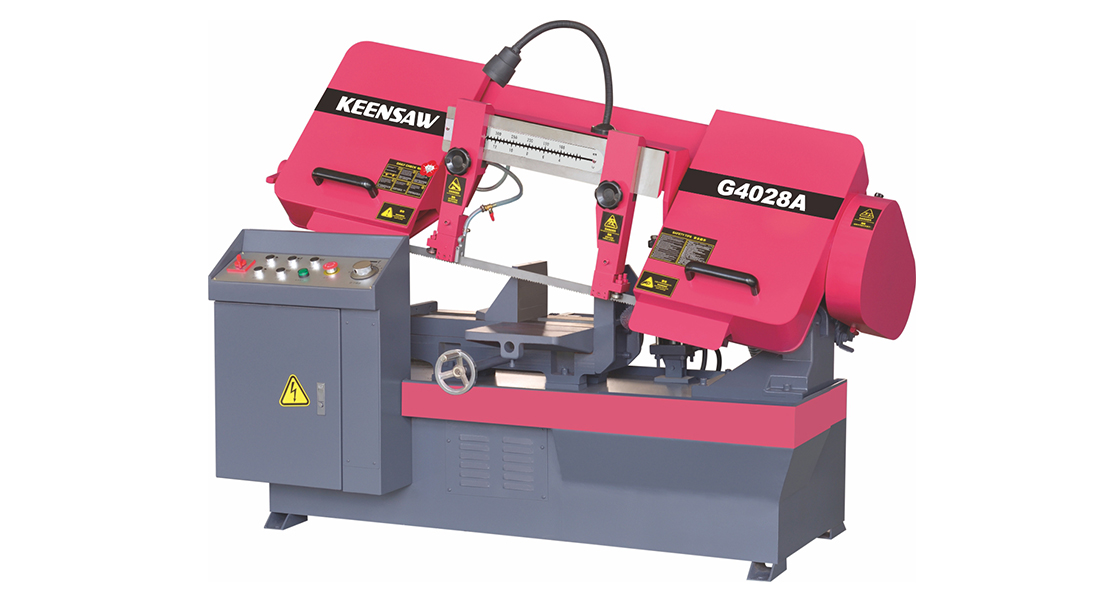
G4028A Semi Automatic Metal Band Saw
Q: Why is a dual-column horizontal bandsaw required for dense solid steels?
A: The twin-pillar framework distributes downfeed cutting forces evenly across the frame, preventing blade deflection and ensuring straight cuts through thick materials.
Q: When should a factory invest in an automatic pipe chamfering machine after a bandsaw cut?
A: You should integrate a chamfering unit when your production line requires high-volume, burr-free edges for automated welding cells or high-speed assembly.
Q: Can CNC pipe bending machines handle thin-walled tubes cut by an industrial bandsaw?
A: Yes, provided the bandsaw delivers a perfectly square cut without crushing the tube walls, allowing the CNC bender to achieve exact radii without wrinkling.
Q: What is the main benefit of sourcing cutting and bending machinery from a single experienced manufacturer?
A: Sourcing from one vendor guarantees structural compatibility and matching tolerances across your entire line while streamlining technical support, warranty claims, and parts logistics.
When upgrading a metal fabrication facility, buying isolated machines from disparate vendors often introduces hidden inefficiencies, tolerance mismatching, and fragmented technical support. True workshop optimization requires looking beyond the immediate cutoff and choosing machinery that elevates the productivity of your entire workforce.
By matching the correct bandsaw machine types to your material geometry, you protect your downstream machinery, reduce material scrap rates, and build a highly repeatable production cycle. Stop treating your cutting department as an afterthought. Explore our engineered line of high-performance Keensaw Band Saw Machines or contact our technical application team today to design a fully synchronized, profitable tube and profile processing line for your business.
Contact us if you have any questions we will reply as soon aspossible