In structural steel fabrication sectors, commercial construction supply chains, and heavy piping industries, processing angled profiles is a daily requirement. Slicing structural steel shapes like H-beams, I-beams, channels, and heavy-walled tubes at precise angles (such as 30°, 45°, or 60°) represents a substantial operational hurdle. Sourcing directors frequently debate the financial return of implementing a specialized mitering band saw machine versus relying on preexisting fixed-frame horizontal saws.
The choice between these two equipment frameworks goes far beyond simple cutting cycle times. It directly dictates the efficiency of your factory floor logistics. Relying on an outdated processing method for compound angle slicing forces excessive manual material movement, creates severe safety hazards under overhead cranes, and introduces dimensional inaccuracies. This engineering analysis compares mitering frameworks against fixed-frame configurations, demonstrating how specialized structural steel cutting equipment eliminates workshop chaos.
A standard fixed-frame horizontal bandsaw is designed to slice metal at a strict 90-degree perpendicular angle. To execute an angled cut on this machinery, operators must manually swing the entire raw material profile relative to the blade plane.
Imagine processing a standard 12-meter structural H-beam. To execute a 45-degree bevel cut on a fixed saw, the operator must crane-lift or manually swing that 12-meter beam out into the workshop’s central aisleway. Swinging heavy stock dynamically reconfigures your floor layout, blocking adjacent material handling channels and halting forklift transit. This disorganized movement squanders valuable factory real estate and introduces severe collision risks into your processing cell.
Furthermore, swinging multi-ton metal stock back and forth makes accurate indexing almost impossible. Every time an operator swings a heavy beam to adjust an angle, the material’s reference datum shifts. This introduces slight variations that cause downstream assembly misalignments during welding, driving up rework expenses and delaying project delivery schedules.
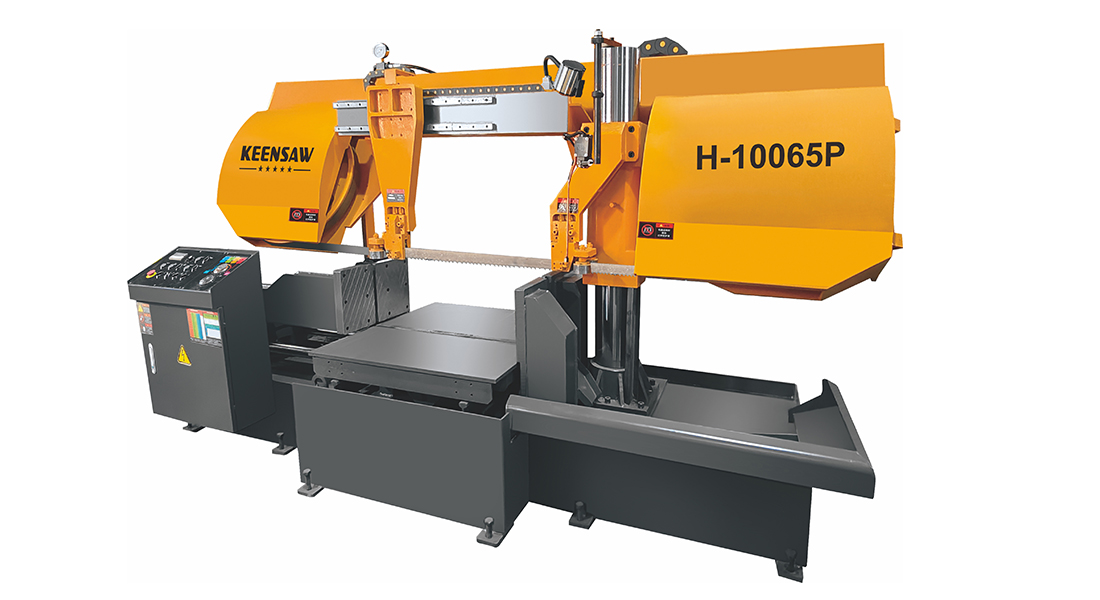
Advanced structural processing facilities eliminate material handling chaos by selecting a specialized swiveling head mitering system rather than moving the raw metal stock.
A true h beam angle sawing center features an innovative swiveling head assembly. The machine’s heavy-duty cast frame rotates smoothly on a precision-machined turntable matrix, while the infeed conveyor line and the heavy steel profile remain fixed on a dead-straight linear plane. To change the cut angle from 90° to 45°, the operator simply unlocks the saw frame and swivels the cutting head. The raw stock continues to feed straight along the conveyor, ensuring zero aisleway disruption.
Structural profiles carry substantial internal residual stresses from the original steel rolling process. As a bandsaw cuts through the wide flanges of an H-beam, these internal stresses relax, causing the metal walls to pinch inward. If the saw frame lacks rigid damping, this compression pinches the blade, causing immediate tooth stripping or catastrophic blade snapping.
Premium mitering saws integrate specialized hydraulic dual-side clamping vises and smart downfeed valves. This hardware locks the material securely on both sides of the blade path and automatically modulates feed pressures when passing through varying wall thicknesses, completely neutralizing blade pinching risks.
Evaluate your floor workflow requirements by reviewing the material handling and spatial impacts of both machinery designs:
| Operational Factor | Fixed Saw Configuration | Swiveling Head Mitering Saw | Workshop Profitability Impact |
|---|---|---|---|
| Raw Stock Alignment | Must swing material (up to 60°) | Remains on fixed 180° linear plane | Eliminates crane handling time by 75% |
| Aisleway Spatial Cost | Extremely high; blocks forklift lanes | Zero floor disruption; fits compact lines | Reclaims up to 40% usable warehouse space |
| Dual-Direction Miter Cuts | Requires completely flipping the beam | Head swivels left and right automatically | Accelerates compound angle batch processing |
*Sourcing Tip: For structural steel shops processing more than 15 tons of angled profiles weekly, transitioning to a swiveling head mitering architecture delivers full capital payback within 9 months.
Sourcing high-performance sawing assets requires an industrial machinery partner that understands advanced material handling dynamics. As an innovative global automatic miter bandsaw manufacturer, KEENSAW manufactures rugged cutting solutions engineered to eliminate operational inefficiencies.
By reviewing the expansive Industrial Mitering Band Saw Machine Portfolio, production directors can choose from a versatile lineup of single-direction and dual-direction swiveling saws. KEENSAW pairs heavy-duty cast iron bow structures with specialized Structural Steel Cutting Equipment and Conveyor Systems. These automated configurations allow factories to feed, clamp, angle-cut, and index oversized shapes cleanly, safely, and with maximum geometric accuracy.
Ready to eliminate floor space bottlenecks and optimize your angle cutting precision?
Q1: What is the main operational difference between a mitering saw vs fixed horizontal saw for structural shapes?
A: A mitering saw rotates its saw bow to the target angle while keeping the material locked on a straight line. A fixed saw requires operators to physically swing the entire raw material profile to adjust the cut angle, which disrupts floor layout logistics.
Q2: Exactly how do swiveling head designs eliminate shop floor chaos?
A: By keeping the material pathway completely straight along the infeed conveyor line, you eliminate the need to swing long beams into central factory aisles, keeping forklift transit lanes completely clear.
Q3: What engineering methods best prevent blade pinching in h beam cutting?
A: You must select a saw equipped with hydraulic split-vises that clamp the material securely on both sides of the blade channel, paired with a constant-pressure downfeed valve that limits feed rate if structural resistance increases.
Q4: What is a swiveling head band saw sizing guide benchmark for handling heavy piping structures?
A: Always calculate your maximum tube diameter at the sharpest planned miter angle (e.g., 45° or 60°), not just the standard 90° capacity. The elliptical footprint of a pipe cut at an angle requires a wider machine vise throat opening.
Q5: Can a mitering bandsaw execute angled cuts in both directions?
A: Yes. Dual-direction mitering bandsaws can swivel both left and right (e.g., up to 60° Left and 45° Right). This feature lets operators execute complex compound cuts without needing to crane-flip the heavy metal profile end-for-end.
Q6: Why is cast iron preferred over welded sheet steel for the swiveling bow frame?
A: Structural shapes create variable resistance as the blade transitions between thin webs and thick flanges. Heavy cast iron absorbing frames damp these structural shocks, protecting teeth from chipping.
Q7: How do digital angle displays protect component manufacturing accuracy?
A: Manual angle scales are prone to operator reading error. Integrated digital angle encoders display the exact angle on the PLC control screen down to a tenth of a degree, ensuring accurate fit-up for structural welding lines.
Q8: What automation additions are ideal for a high-volume pipe angle cut off center?
A: Integrating motorized roller conveyors with laser-aligned material end stops lets operators index heavy pipes quickly and precisely, maximizing daily tonnage throughput.
Q9: Is a laser guide line system useful for structural angle cutting?
A: Yes. A laser tracking module projects a clear reference line directly onto the material’s surface, letting operators quickly verify their manual measurement lines against the blade’s entry point.
Q10: Where can structural steel shops get tailored turnkey logistics consultation?
A: Connect directly with the technical engineering team at KEENSAW. We design customized material loading networks, automated conveyors, and heavy-duty mitering cells tailored to your shop’s specific floor dimensions.
Contact us if you have any questions we will reply as soon aspossible