Yes, and most factories that buy one do exactly that: solid bar in the morning, hollow tube in the afternoon. The machine does not change, but three settings do, and getting them wrong is how you end up with crushed tube ends or a blade that only lasts a week on bar stock. This article breaks down what actually differs between the two workpiece types, what to check on the machine before you switch, and how to decide whether one dual-purpose saw is enough or whether you need two.
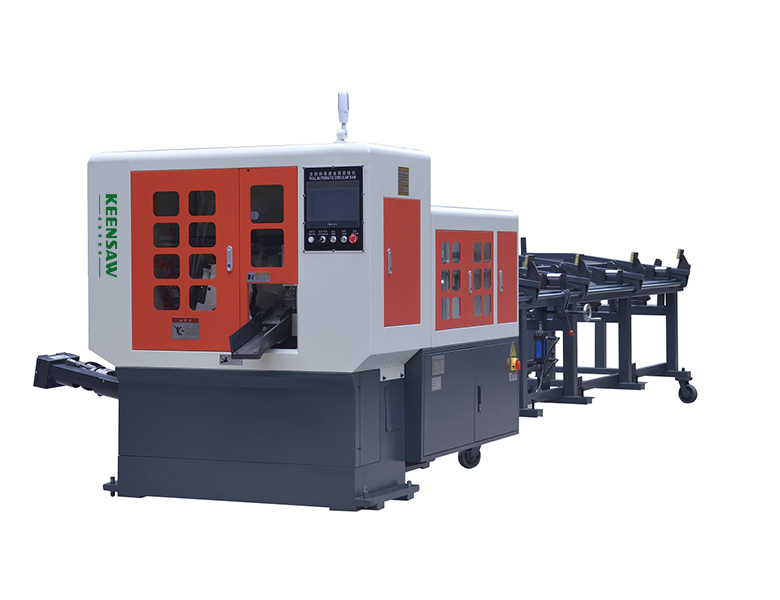
A metal cutting circular saw machine can cut bar and tube on the same bed as long as it has two things: a clamping system that can hold a hollow section without collapsing it, and a blade and speed range wide enough to cover both a solid section and a thin wall. If you only ever run one diameter of solid bar, almost any carbide saw will do. If you switch between materials daily, the clamp design and the control’s ability to store recipes matters more than the motor size.
Take the KCS-160C as a working example. It handles round stock from 40 to 160 mm and square stock from 40 to 105 mm with a 460 mm TCT blade, holding ±0.1 mm on length. Nothing in that spec separates bar from tube, because the separation happens at the vise and in the feed profile, not in the capacity table.
| Element | Solid bar | Hollow tube |
|---|---|---|
| Clamping | High pressure, flat jaws, vertical clamp does most of the work | Lower pressure, profile or wide jaws, horizontal clamp prevents ovalising |
| Blade selection | Coarser pitch, robust tooth, more power available for the cut | Finer pitch at the exit, positive rake, thin kerf to limit burr |
| Spindle speed | Set by material and diameter, less sensitive to section | Has to be limited by wall thickness, not by OD |
| Feed profile | Constant through the whole cut | Slow at entry and exit, faster through the wall |
| Failure mode | Blade overload, spindle stall, heat discolouration | Wall collapse, exit burr, tube pulled forward |
A solid bar can take enormous clamp pressure because there is no void to collapse. A tube cannot. If you leave the pressure set for bar and then load a 2 mm wall tube, the vise closes the section by a few tenths before the blade even touches it, and no downstream operation will bring that round section back. The machine pictured above uses both horizontal and vertical clamping, which is what lets it hold tube from two directions at moderate pressure instead of squeezing it from one side at high pressure.
The practical answer is a pressure setting stored per recipe. Save one program per workpiece family with its own clamp pressure, feed profile and blade, and switch programs instead of adjusting valves by feel.
On solid bar the blade spends its whole travel inside material, so chip clearance and tooth strength dominate. On tube the blade cuts two walls and then runs through air, which means the tooth exits into nothing and the unsupported burr rolls over. That is why a blade that is perfect on 60 mm bar can leave a heavy burr on 60 mm tube. A finer tooth count and a slightly positive rake give a cleaner exit; a thin kerf reduces the cutting force and the burr with it.
If you cut both sections every day, keep two blades and label them. Swapping a blade takes a few minutes and costs far less than the scrap you generate with the wrong one. The saw blade range is organised by application for exactly this reason.
When you move from bar to tube on the same machine, run these five checks in order. Ten minutes here saves an hour of scrap.
Switching between bar and tube every day?
The KCS-160C uses a 15 kW spindle, 18-150 rpm variable speed and horizontal plus vertical clamping, so one machine covers both sections with stored recipes. Send us your bar and tube sizes and we will confirm the blade set for each.
One dual-purpose saw makes sense up to a point. Two situations push you toward a dedicated machine: when the tube wall is thin enough that even careful clamping leaves a mark, and when bar volume is high enough that blade changes for tube interrupt the bar line. In the first case a rotary tube cutting machine supports the wall from every side. In the second, a dedicated bar saw pays back quickly because the whole cycle, including the clamp, is tuned for solid stock.
The honest test is downtime, not capacity. If you spend more than about 30 minutes a day changing over and re-setting, the second machine is cheaper than the lost output. If you change once a week, one machine is right. You can model that trade-off with the cost-per-cut comparison before you commit.
Do I need a different blade guard when cutting tube instead of bar?
No, the guard follows the blade diameter, not the workpiece. What does change is the blade projection below the work. Keep it as small as the section allows so the unsupported tooth has less chance to hook and lift the tube.
Can a saw rated for 160 mm round bar cut 160 mm square tube?
Usually not. Square capacity is smaller than round capacity on the same machine because the diagonal is what passes under the blade. On the KCS-160C the round limit is 160 mm while the square limit is 105 mm, so always quote the section shape when you compare models.
Why does tube cut slower than bar of the same diameter?
Because you are cutting two thin sections instead of one solid one, and each entry and exit has to be controlled to avoid burr and vibration. The metal removal rate is lower, so the feed can be higher through the wall but the total cycle is still limited by how carefully you enter and leave the cut.
Is a bundle clamp worth adding for small tube?
If you cut under about 20 mm OD in volume, yes. Cutting a stack of tubes at once multiplies output and each tube supports its neighbour, which reduces ovalising. It does demand a consistent tube length and straightness, so reject bent bundles before loading them.
What causes a shiny ring on the outside of the tube after cutting?
That is jaw marking from a clamp set too tight or a jaw with a worn, polished face. It does not affect the cut but it fails cosmetic inspection and it can start a corrosion site on stainless, so treat it as a clamping issue rather than a blade issue.
Can I cut aluminium and steel on the same circular saw?
Physically yes, practically it is a compromise. Aluminium wants high speed, a large gullet and a blade designed to clear soft chips. Steel wants lower speed and a stronger tooth. Running steel on an aluminium blade packs chips and overheats the tooth, so keep separate blades and clean the machine between materials.
How do I know if the machine is underpowered for solid bar?
Watch the spindle load meter and the colour of the chips. If load sits near the limit through a normal cut and the chips come off blue, the machine is working at its ceiling and any harder grade will stall it. A machine that is correctly sized for the bar shows a comfortable load margin.
Does the feed length limit restrict how long a piece I can cut?
Not the piece length, only the single-stroke index. If the machine indexes 800 mm at a time it can still cut a 2,400 mm part by indexing three times, as long as the control supports multi-stroke feeding and the table is long enough to take the part away.
Why is the first piece of a new batch always slightly different?
The machine is cold and the hydraulic oil is at ambient temperature, so clamp force and feed response are not yet at their stable values. Run two warm-up cuts and scrap them, or let the machine idle through a few cycles before you measure the batch.
Should I buy a CNC circular saw or a manual cold saw for mixed bar and tube work?
If you change sections more than once a week, CNC wins on repeatability alone, because the recipe stores clamp pressure and feed with the length. A manual saw is fine for one-offs and job work where the operator sets each cut by hand anyway.
Keep reading
Background on the machine class in what a circular saw machine is and how the types differ, and why cut cost matters more than cut speed in the cost-per-cut model.
Equipment
Start with the KCS-160C bar and tube saw, or browse the CNC circular saw range for higher volume lines.
One circular saw can absolutely cover both bar and tube. What it cannot do is cover both with one setting. Treat clamp pressure, blade and feed as a recipe per workpiece family, verify the first three pieces after every change, and a single machine will hold tolerance on both sections for years. Where the compromise becomes expensive is thin wall at high volume, and that is the point to look at a rotary machine rather than a bigger saw. Tell us the sections you run and how often you change them, and we will tell you honestly whether one machine is enough.
Contact us if you have any questions we will reply as soon aspossible