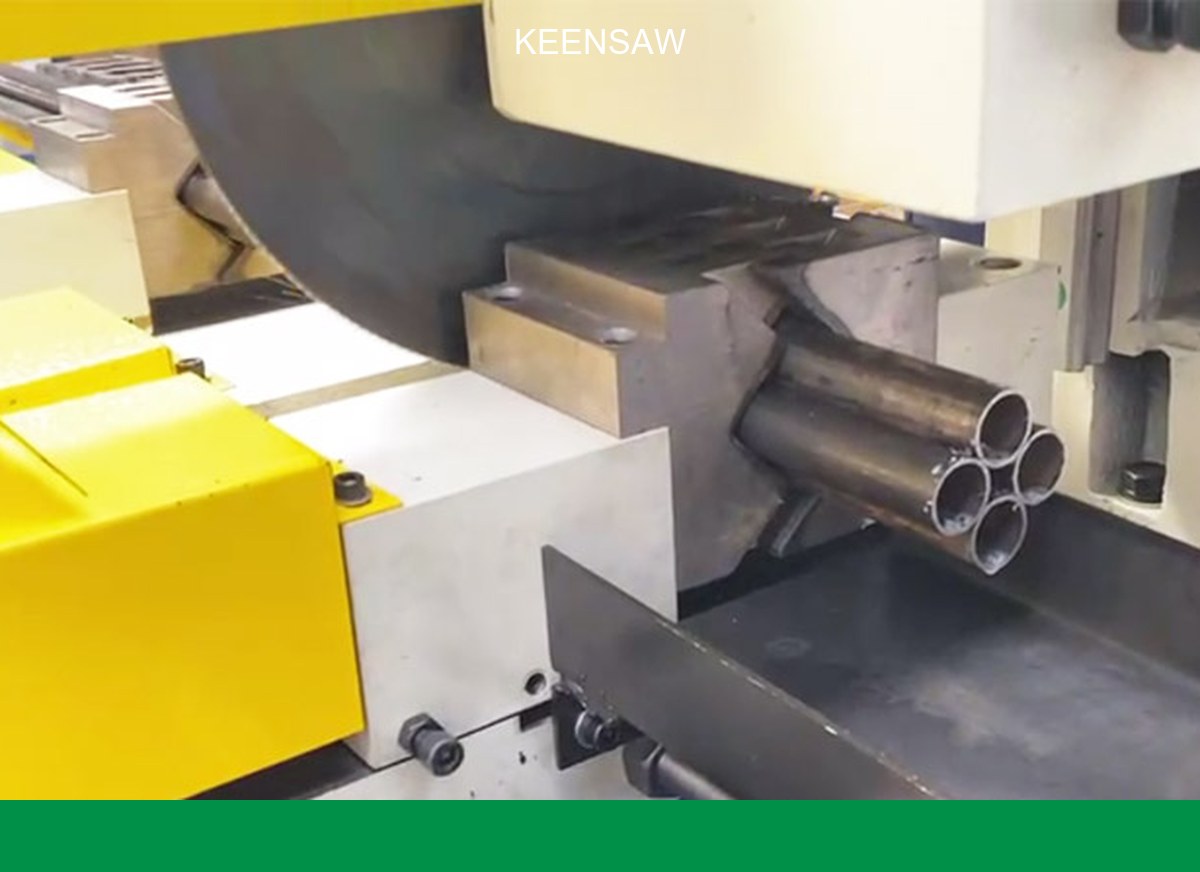
Short answer: A cold saw machine delivers the lower cost-per-cut above roughly 4,000–6,000 cuts per month on bars up to 160 mm, because its TCT/cermet blade removes almost no material (near-zero kerf), needs no deburring or recut, and holds ±0.1 mm length — so you stop paying for scrap, secondary operations, and operator time. A band saw machine wins only at low volume, very large sections, or where one machine must cut every shape on the floor. Below ~4,000 cuts/month the band saw’s lower capital cost usually beats the cold saw’s lower per-cut cost.
Most buyers compare sticker price. That is the wrong number. The number procurement and estimating actually live by is cost-per-cut — the fully loaded cost to produce one finished, dimensionally accurate cutoff piece, ready for the next operation:
| Cost component | Cold saw | Band saw |
|---|---|---|
| Blade / consumable per cut | Very low (TCT, long life) | Low–moderate (bi-metal wears) |
| Material lost to kerf | ~2–3.5 mm (near zero) | ~1.0–1.4 mm (still lost) |
| Deburring / facing after cut | Usually none | Required (extra labor) |
| Cycle time per cut (Ø60 steel) | 4–7 s | 15–45 s |
| Operator attention | Minimal (auto feed) | Moderate |
| Capital cost | Higher | Lower |
A cold saw cuts with a toothed circular blade (TCT or cermet) that shears the material without generating the heat and burr a band saw leaves. Three mechanisms drive the saving:
The band saw is not obsolete — it is the right tool when:
| Metric | Cold saw (KCS-160C class) | Band saw (530TS class) |
|---|---|---|
| Cycle time | 5 s | 30 s |
| Cuts/hour (net) | ~650 | ~110 |
| Blade cost / 1,000 cuts | ~$18 | ~$26 |
| Deburr labor / cut | $0 | ~$0.12 |
| Est. loaded cost / cut | ~$0.21 | ~$0.34 |
At 1,000 cuts/day the cold saw saves roughly $0.13/cut × 250,000 = $32,500/year — before counting scrap and floor-space savings. The CNC circular saw vs cold saw guide breaks the blade-economy math down further.
| Monthly volume | Lower cost-per-cut | Lower total cost of ownership |
|---|---|---|
| < 3,000 cuts | Band saw | Band saw |
| 3,000–6,000 cuts | Cold saw (per cut) | Band saw (capex still) |
| > 6,000 cuts | Cold saw | Cold saw |
For a like-for-like evaluation, benchmark against these production machines:
All cold saws are circular saws, but not all circular saws are cold saws. A “cold saw” specifically uses a low-RPM toothed TCT/cermet blade that cuts without heating the workpiece; high-speed abrasive or dry circular cutters are different machines.
The cold saw. Ends are square, burr-free, and cool, holding ±0.1 mm — ideal before machining or a cutting-and-chamfering line.
Yes. Band saws reach 330–650 mm; circular cold saws top out around 180–220 mm capacity. For billets and beams, the band saw or a laser/plasma option is required.
For a shop running 6,000+ cuts/month, the per-cut saving plus deburr-labor elimination typically pays back the cold saw premium in 12–20 months.
Often yes — keep a band saw for large/odd sections and low-volume work, and put the cold saw on the high-volume line where it earns its keep.
Send your monthly volume, bar diameter, and material to the KEENSAW team and they will size the KCS circular saw or 530TS band saw to your line.
Tell KEENSAW your material, diameter, and monthly volume — they will model cold-saw vs band-saw cost-per-cut on your exact parts and recommend the configuration with the lowest total cost of ownership. Request a quote →
Contact us if you have any questions we will reply as soon aspossible