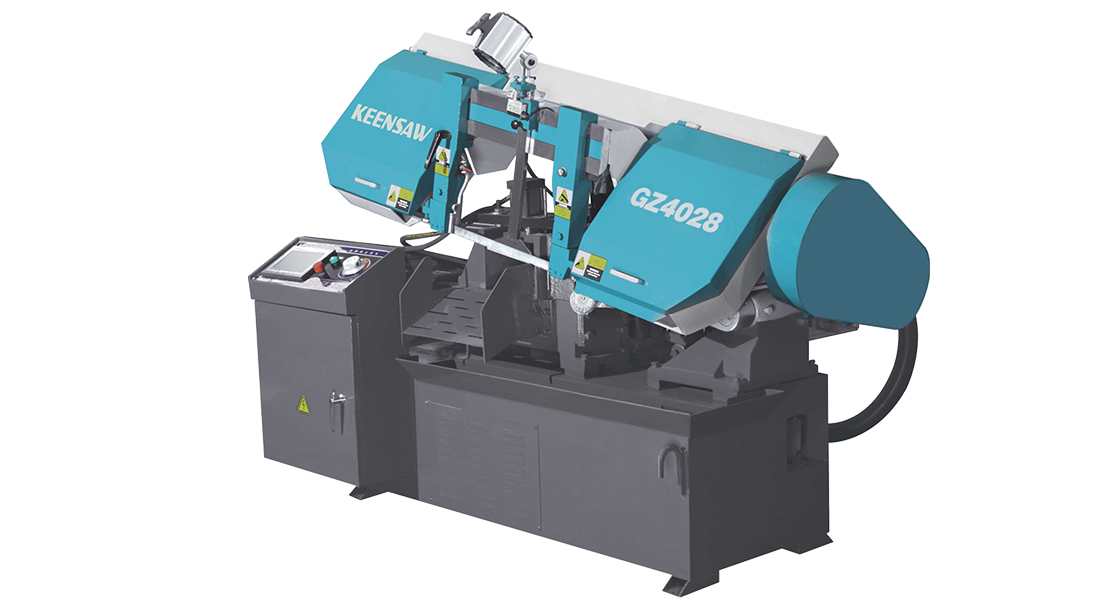
In industrial procurement, purchasing metal fabrication machinery involves balancing immediate production needs with capital expenditure (CAPEX). When search data indicates buyers are asking, “What bandsaw size do I need?” many general guides mistake this for a question about consumable blade lengths. However, for plant managers, workshop owners, and sourcing professionals, the real question is about machine capacity and structural scaling.
Choosing the wrong industrial saw size carries massive operational penalties. Under-sizing a machine leads to overloaded motors, blade binding, and an inability to accept large raw materials, creating permanent production bottlenecks. Conversely, over-sizing results in unnecessary floor space consumption, excessive initial investment, and inflated power costs. This comprehensive guide details how to calculate the exact industrial Keensaw Band Saw Machine size your workshop requires based on material throughput, geometric capacities, and automated line constraints.
When evaluating an industrial horizontal or vertical saw, the most critical specification on the data sheet is its Cutting Capacity. This represents the physical limits of the machine’s structural opening—often referred to as the “envelope.”
+-------------------------------------------------------------+
|                MACHINE THROAT CAPACITY ENVELOPE             |
|                                                             |
|   O  Round Stock Capacity (Max Diameter)                    |
|                                                             |
|   [] Rectangular / Square Capacity (Width x Height)         |
+-------------------------------------------------------------+
Industrial saws categorize their sizing based on the maximum diameter of round solid bars they can cut at a 90-degree angle (e.g., 250mm, 320mm, 400mm, or 500mm+).
The 80% Rule for Longevity: To protect your machinery from premature structural fatigue, your average daily production stock should occupy roughly 70% to 80% of the machine’s maximum round capacity. If you regularly cut 300mm solid steel billets, do not purchase a 300mm maximum capacity saw; opt for a 400mm heavy-duty dual-column model to provide adequate mechanical headroom.
Because a bandsaw blade travels horizontally through a frame, the rectangular capacity is often wider than it is tall. For structural steel fabricators dealing with wide H-beams, wide-flange channels, or large welded plate assemblies, the cross-sectional width ($W \times H$) is the deciding factor. Ensure the vice jaws open wide enough to accommodate the material’s widest orientation, especially if you plan to execute angle miter cuts.
A machine’s “size” isn’t just about how wide its vises open; it is also defined by its torque capability and structural weight.
The physical footprint of an industrial horizontal bandsaw scales directly with its main drive motor power.
Small to Mid-Sized Saws (2.2 kW to 3.7 kW): Ideal for thin-walled tubes, small structural profiles, and carbon steel rods.
Heavy-Duty Industrial Saws (5.5 kW to 7.5 kW+): Necessary for pushing large blades through dense, tough alloys like Inconel, stainless steel, and tool steel without slowing down the blade speed or overheating the gearbox.
A light-frame saw vibrating under the stress of high-speed cutting(To understand how machine structure counteracts these forces, read our comparison on different bandsaw machine types.) will ruin high-grade bi-metal or carbide blades in hours. True industrial-grade saws utilize heavy cast-iron or thick-welded steel structures to absorb harmonics. When comparing machine sizes, check the total net weight: a dual-column machine designed for 400mm solids should weigh several tons, signaling the rigidity required for dead-straight cuts.
The amount of floor space and structural length your machine requires depends heavily on its level of material handling automation.
On these models, material positioning is managed manually by the operator or via a simple mechanical stop on a non-powered roller table. The footprint is localized mostly to the machine base itself, making it highly suitable for toolrooms, maintenance shops, and low-volume fabricators.
Automatic CNC bandsaws incorporate an integrated hydraulic shuttle vise system that automatically advances the raw material bundle forward between cuts.
Shuttle Stroke Sizing: Pay close attention to the “single index stroke” parameter (e.g., 500mm or 600mm). If your production line requires frequent cut-off lengths of 1200mm, a machine with a 600mm single stroke will need to cycle the shuttle vise twice per cut. For ultra-long parts, sourcing an extended shuttle stroke customization drastically cuts cycle times and enhances throughput.
To simplify your procurement roadmap, use this industrial sizing framework to find the right equipment class within the Keensaw Band Saw Machine lineup:
| Application Profile | Target Material Sizes | Recommended Machine Class | Typical Drive Motor Power |
| Small Maintenance & Custom Tooling Shops | Round solids $< 250\text{mm}$, light angles | Pivot-Style Semi-Automatic Horizontal | $2.2\text{ kW}$ |
| Mid-Volume Fabricators & HVAC Tube Cutting | Bundled tubes, Medium profiles $< 320\text{mm}$ | Double-Column Automatic CNC (Mid-Size) | $3.7\text{ kW}$ |
| Heavy Steel Service Centers & Forging Plants | Solid billets, Heavy H-beams $> 400\text{mm}$ | Heavy-Duty Dual-Column Horizontal | $5.5\text{ kW} – 7.5\text{ kW}+$ |
| High-Precision Aerospace & Alloy Cutting | Exotic hard alloys, Titanium, Tool steel | High-Rigidity CNC with VFD Speed Control | Custom Premium Setup |
Q: What happens if I use a small-sized bandsaw to cut large solid steel blocks close to its maximum capacity limit?
A: While it may physically complete the cut, running a machine constantly at its geometric limit overloads the motor, causes the blade to flex (resulting in crooked cuts), and accelerates mechanical wear on the gearbox.
Q: How does material bundle cutting affect the machine size selection?
A: When cutting bundles, you must evaluate the machine’s maximum envelope in “bundle configuration,” which is smaller than its single-piece capacity due to the space required for the hydraulic top-clamping cylinders.
Q: Why does machine frame weight matter when selecting a bandsaw size?
A: Greater structural weight absorbs the cutting vibrations generated during high-speed penetration. A heavier, more rigid frame ensures straighter cuts and significantly extends the life of expensive carbide blades.
Q: What is a “shuttle stroke” on an automatic CNC bandsaw machine?
A: It is the maximum length the automatic feeding vise can advance the raw material in a single mechanical motion. For long parts, a longer single stroke minimizes cycle times by reducing index indexing resets.
Selecting the right industrial saw size requires looking beyond today’s purchase order. A saw that perfectly matches your current maximum material dimensions today will leave your facility stranded when a client requests processing for larger structural beams or denser solid alloys tomorrow. Investing in a machine frame with built-in sizing redundancy is a strategic move that future-proofs your cutting department.
Explore our exhaustive breakdown of geometric dimensions, weight capacities, and power configurations by visiting our dedicated Keensaw Band Saw Machines category page. Connect with a Keensaw application engineer today to map out the exact machinery dimensions your upcoming production goals require.
Contact us if you have any questions we will reply as soon aspossible