In any metal fabrication or industrial manufacturing setup, throughput is the heartbeat of profitability. When production demands scale, many plant managers face a common bottleneck: their current cutting department cannot keep up with raw material preparation. Traditional cutting methods—like standard abrasive saws or manual torching—eventually reach their physical limits when handling larger profiles, thick-walled tubes, or dense billets.
If you find yourself asking, “Why do I need a bandsaw machine when I already have other cutting tools?” you are looking at the question from a tactical perspective rather than a strategic one. An industrial-grade band saw machine is not just a tool for making a cutoff; it is a critical piece of infrastructure designed to lower your cost-per-cut, minimize raw material waste, and streamline the workflow for your entire production line.
To understand why global manufacturing hubs rely so heavily on heavy-duty band saws, we must examine the specific engineering and financial advantages these machines bring to a high-volume shop floor.
Circular saws are structurally limited by the radius of their blades(To learn more about selecting the right consumables, check out our guide on different bandsaw blade types); you can only cut materials that are smaller than half the blade diameter minus the gearbox clearance. This makes cutting massive solid bars or extra-large structural H-beams nearly impossible or cost-prohibitive with circular technology.
An industrial band saw machine utilizes a continuous flexible loop blade driven around two heavy flywheels. This unique design allows for massive throat capacities, enabling you to cut solid steel cylinders and heavy rectangular profiles that would bottleneck other departments.
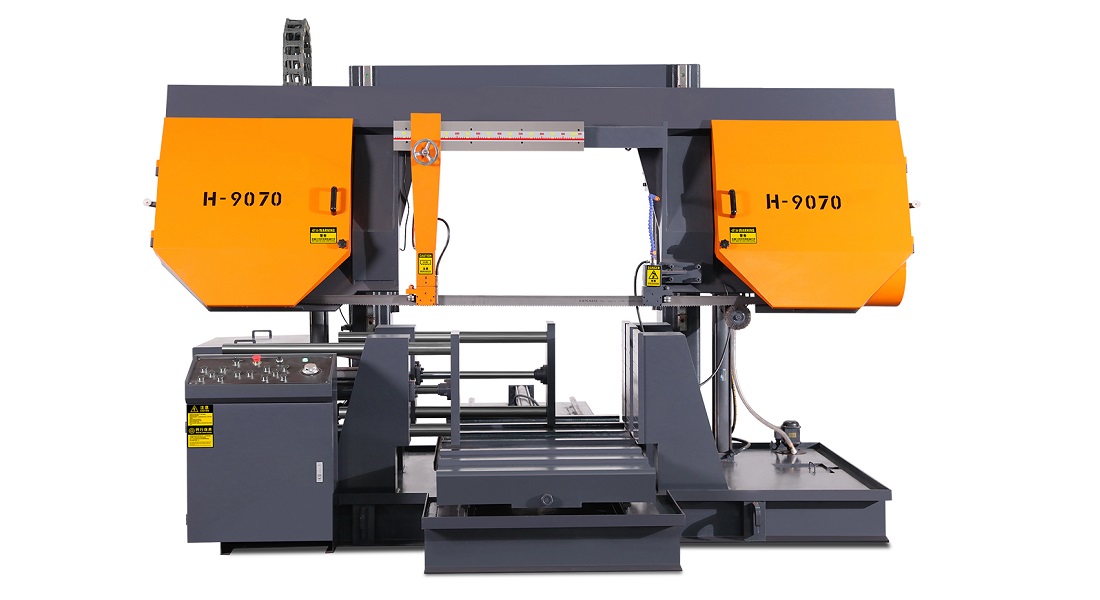
H 9070 semi automatic band saw with double column
In industrial metal processing, raw materials constitute the largest recurring expense. Every time a saw cuts a piece of metal, a portion of that metal is turned into useless dust or chips. This loss is determined by the “kerf”—the thickness of the cut itself.
Circular cold saw blades or abrasive discs can be several millimeters thick. In contrast, a high-quality industrial band saw blade is incredibly thin, often measuring less than 1.5mm in thickness. While a difference of 2mm to 3mm per cut seems negligible on a single piece, consider a production run of 10,000 cuts on expensive stainless steel or titanium alloy bars. By choosing a band saw, you save thousands of millimeters of raw material, effectively getting “free” pieces out of every stock bundle.
A single industrial band saw machine can transition from cutting soft structural aluminum profiles to hardened tool steel, inconel, or titanium within minutes. This adaptability is achieved simply by adjusting the machine’s variable speed drive and swapping out the blade to match the material density. It eliminates the need to buy multiple specialized cutting stations for different metal families.
To make an informed purchasing decision for your workshop, it helps to see how the band saw stacks up against traditional industrial cutting solutions across critical business metrics.
| Performance Metric | Traditional Circular Saw | Flame / Plasma Cutting | Keensaw Industrial Band Saw Machine |
| Maximum Cutting Capacity | Limited by blade radius (Small to medium) | High capacity but limited to sheet/plate shapes | Virtually unlimited for heavy solids and structures |
| Material Kerf Loss (Waste) | High (Thick blades create massive chip volume) | Very high (Creates a wide heat-affected zone) | Extremely Low (Thin flexible blades save raw metal) |
| Edge Finish Quality | Clean, but prone to blade thermal stress | Rough edge; requires heavy secondary grinding | Smooth, uniform finish ready for welding or CNC machining |
| Automation Potential | Moderate automatic feeding cycles | High setup times for non-plate stock | Excellent (Fully integrated automatic bundle loaders) |
When evaluating your workshop’s return on investment (ROI), it is crucial to understand that not all band saws are engineered equal. Many light-duty saws struggle with “blade wandering” or frequent structural failures when pushed under heavy industrial cycles.
Premium industrial units are constructed using a rigid, heavy-cast iron or vibration-dampening steel frame. This structural mass absorbs the intense counter-forces generated during high-speed metal penetration.
Furthermore, true industrial machines incorporate two vital assemblies:
Carbide Blade Guide Systems: These act as rigid stabilizers that grip the flexible blade right before it enters the metal, ensuring the tooth line remains perfectly vertical throughout the entire depth of the cut.
Hydraulic Tensioning and Clamping: Manual tensioning leads to human error—either undertensioning (which causes crooked cuts) or overtensioning (which snaps blades). Hydraulic systems maintain an unyielding, consistent pressure, protecting your machine components and extending blade life indefinitely.
Identifying that you need a band saw is only the first step; you must also select the control framework that aligns with your operational structure.
Ideal for mid-sized maintenance facilities or machine shops handling varied, short-run jobs. The operator manually positions the material to length, but the clamping, blade start, downward cutting feed, and frame lift are entirely controlled by automated hydraulic systems. This removes physical strain from the worker and guarantees a uniform downfeed rate.
For mass production facilities, steel service centers, and high-volume automotive parts suppliers, a fully automatic CNC machine is mandatory. These systems allow an operator to load an entire bundle of steel bars into a magazine, program the desired cut lengths and quantities via a digital touch screen, and walk away. The machine handles the index feeding, bundle clamping, precision cutting, and trim-cut sorting 24/7 without human intervention.
Q: What is the primary advantage of an industrial band saw machine over a circular cold saw?
A: Band saws offer a much larger cutting capacity and produce a narrower kerf, significantly saving raw material costs on large-diameter solid profiles.
Q: Can an industrial metal cutting bandsaw machine handle extremely hard aerospace alloys?
A: Yes, when configured with premium carbide-tipped blades, variable frequency speed control, and high-pressure flood coolant systems, it can efficiently slice through titanium, inconel, and tool steels.
Q: What structural features should I look for to avoid crooked or wavy cuts?
A: Look for a heavy dual-column frame design, rigid hydraulic blade tensioning, and high-quality carbide blade guide inserts that prevent the blade from twisting under stress.
Q: How does upgrading to an automatic CNC band saw improve overall workshop ROI?
A: It minimizes manual labor hours, drastically reduces human positioning errors, optimizes blade consumption through controlled feed rates, and drastically accelerates cycle times.
Investing in a high-caliber metal cutting machine is one of the fastest ways to eliminate structural bottlenecks, slash operational overhead, and gain a competitive edge in your market. Don’t let an outdated, underpowered saw dictate the pace and capacity of your business growth.
Explore the full engineering specifications and discover the perfect cutting solution for your facility by reviewing our comprehensive selection of high-performance Keensaw Band Saw Machines. Ready to optimize your workflow? Contact our application engineering team today to receive a detailed cost-benefit analysis tailored specifically to your material requirements.
Contact us if you have any questions we will reply as soon aspossible